
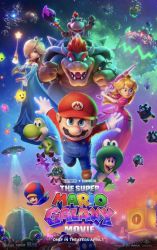
A Mushroom Kingdom Adventure Finally Finds the Stars
I watched The Super Mario Galaxy Movie with the feeling that the Mario film universe had been waiting for this exact leap. The first movie had to introduce the Mushroom Kingdom, the pipes, the power-ups, the bright kingdoms, the familiar enemies, and the basic rhythm of Mario on screen. This sequel gets to do something bigger and stranger. It takes that colorful foundation and throws it into space, where planets are tiny, gravity bends like a toy, stars have personalities, and the Mario logic suddenly feels even more cinematic.
What I liked most is how naturally the Galaxy concept fits the franchise. Mario has always been built on movement, surprise, and playful rules. Space gives those ideas a larger playground. Instead of only running across platforms, characters can hop between planetoids, fall upward, spin through star paths, and treat gravity as part of the joke. The film feels at its best when it stops trying to explain the absurdity and simply trusts that Mario’s world has always made emotional sense through motion, color, and clear goals.
Mario Feels More Comfortable as a Hero This Time
Chris Pratt’s Mario feels more settled in this sequel. In the first movie, he was still learning the rules of a strange new world. Here, I liked seeing him act with more confidence without becoming too polished. He is still the same earnest, slightly overwhelmed plumber at heart, but he now understands that impossible adventures are part of his life. That gives the character a more relaxed charm.
Mario works best for me when he is defined by persistence rather than perfection. He is not the strongest, tallest, or most mystical figure in the story. He keeps going because giving up does not seem to occur to him for long. In a Galaxy story, that trait matters. Space is disorienting, vast, and full of strange rules, but Mario’s emotional logic remains simple: help his friends, keep moving, and jump toward the next impossible thing.
Luigi Brings Nervous Comedy With Real Loyalty
Charlie Day’s Luigi continues to be one of the franchise’s funniest emotional anchors. I enjoy how Luigi can be scared of nearly everything and still remain loyal when it counts. His anxiety does not make him useless. It makes him more human. In a cosmic adventure, where the scale is larger and the danger feels more surreal, Luigi’s nervous reactions help keep the story grounded.
What I liked is that Luigi’s fear often reveals the absurdity of the world more clearly than Mario’s confidence does. Mario jumps forward because that is who he is. Luigi pauses and seems to ask what any reasonable person would ask: why is gravity sideways, why is that star talking, and why is space somehow full of platforms? His reactions make the film funnier, but his loyalty gives the comedy warmth.
Princess Peach Becomes a Cosmic Leader
Anya Taylor-Joy’s Peach remains active, capable, and composed, and the Galaxy setting gives her a broader stage. I liked how the film treats her not only as a royal figure, but as someone who can think strategically in unfamiliar territory. She has already been shown as brave and skilled, but space adds a new test. The Mushroom Kingdom’s usual rules no longer apply, and Peach has to adapt as much as everyone else.
Her leadership style is different from Mario’s. Mario is instinctive and direct. Peach is more controlled, observant, and diplomatic. That contrast works well, especially when the story moves beyond familiar kingdoms into cosmic spaces connected to Rosalina and the Lumas. Peach helps the film feel less like a simple rescue adventure and more like a journey through larger responsibilities.
Rosalina Gives the Movie Its Mythic Glow
Rosalina is the character I was most curious about, because she carries a very different emotional tone from most Mario characters. Brie Larson’s Rosalina brings a calm, distant, almost storybook quality to the film. I liked how her presence changes the mood. When she appears, the world feels older, quieter, and more mysterious, as if the bright Mario universe has suddenly opened a door into cosmic memory.
Rosalina matters because she gives the movie a sense of wonder beyond action. She is connected to the stars, the Lumas, and a softer kind of loneliness that the Mario films have not explored as deeply before. Her scenes work best when they slow the pace slightly and allow the universe to feel vast. In a franchise built on energetic movement, Rosalina brings stillness, and that stillness makes the stars feel meaningful rather than merely decorative.
Bowser Jr. Adds Mischief With a Family Grudge
Benny Safdie’s Bowser Jr. gives the sequel a fresh source of chaos. I liked the idea of bringing Bowser’s son into the story because it changes the villain dynamic. Bowser is still theatrical, dramatic, and convinced of his own grandeur, but Bowser Jr. adds a more personal motivation. He is not only causing trouble for power. He wants to restore his father’s status and prove himself in the process.
That family angle makes the villain side funnier and more specific. Bowser Jr. has the energy of a spoiled heir with dangerous tools and a very emotional attachment to his father’s reputation. His schemes feel childish in impulse but huge in consequence. That is a good match for Mario’s world, where personal grudges can become planet-sized problems if enough magic, machines, or stars are involved.
Bowser Remains the Franchise’s Loudest Drama King
Jack Black’s Bowser continues to be a major source of comic force. His villainy works because it is always mixed with theatrical feeling. He is huge, fiery, proud, and absurdly emotional. I enjoy that he can seem dangerous one moment and then become hilariously needy the next. That contradiction is exactly what made him stand out in the first film, and the sequel keeps that energy alive.
In The Super Mario Galaxy Movie, Bowser’s situation gives him a slightly different comic position. His power has been challenged, and that makes his ego even louder. I liked watching the story use him as both threat and punchline. Bowser believes he deserves awe at all times, but the universe does not always cooperate. Space is big enough to make even Bowser look ridiculous, and that is part of the fun.
The Lumas Bring Sweetness With a Strange Edge
The Lumas are one of the film’s most charming visual elements. They are tiny, glowing, and cute in a way that seems designed for instant affection, but I liked that they also bring a slightly odd energy. Mario’s universe is often cheerful, yet the Galaxy side has always had a dreamy, bittersweet feeling. The Lumas help carry that tone.
Their presence gives the movie softness without slowing it down too much. They make space feel alive, not empty. They also connect the adventure to Rosalina’s more emotional mythology. In a story full of movement, jokes, and action, the Lumas add moments of wonder. Their glow makes the universe feel like a nursery, a map, and a mystery all at once.
The Aesthetics Turn Space Into a Playground
The visual style is where The Super Mario Galaxy Movie really gets to shine. I loved how space is not treated as a dark void. It is bright, colorful, musical, and full of toy-like planets with their own little rules. One world can be icy, another grassy, another mechanical, another filled with floating platforms and impossible paths. The film understands that Mario space should not look like hard science fiction. It should look like a dream designed around jumping.
The small planets are especially fun because they create a sense of constant visual surprise. Characters can run around a globe, flip orientation, launch into the sky, and land somewhere that feels close and far at the same time. This makes the action feel different from the first movie. The camera has more freedom, the environments are more playful, and every new location can introduce a fresh rule.
Gravity Becomes the Movie’s Best Toy
The Galaxy games were famous for making gravity playful, and the movie benefits from that idea. I liked how gravity is used not only for spectacle, but for comedy and tension. A character can fall in the wrong direction, chase someone around a tiny planet, or misjudge a jump because the floor is suddenly above them. That gives the film a physical identity that feels connected to the games.
What makes this work is clarity. Even when the movement becomes wild, I still need to understand where characters are going and why a jump matters. The best sequences keep that readable. Mario’s action has always been about simple goals made exciting through movement. The movie understands that. It turns cosmic physics into a colorful obstacle course rather than a confusing visual storm.
The Music Carries Game Memory Into Movie Scale
Brian Tyler’s score has a major job because Mario music is instantly recognizable. The Galaxy setting raises the stakes, because the original games are remembered not only for their mechanics, but also for their sweeping, orchestral sound. I liked how the film uses music to make the universe feel grand while still preserving the playful bounce of Mario.
The strongest musical moments are the ones that mix adventure with wonder. Space should feel exciting, but it should also feel a little magical. The score helps create that feeling. Familiar musical touches give fans recognition, while larger orchestral passages make the journey feel cinematic. I especially enjoyed when the music allowed small moments of awe to breathe before the next comic or action beat arrived.
Yoshi Adds Joyful Creature Energy
Yoshi’s presence gives the movie a fresh burst of charm. The character fits naturally into Mario’s world because he brings movement, cuteness, and utility all at once. I liked how Yoshi changes the rhythm of scenes. He is not only a mascot figure. He adds another form of physical comedy and adventure, especially when the story uses his abilities in playful ways.
What makes Yoshi appealing is his simplicity. He does not need complicated motivation to be fun. His design, sounds, speed, and expressive reactions do a lot of the work. In a cosmic sequel with bigger mythology and new characters, Yoshi helps keep the film tied to the pure joy of Mario gameplay: ride, jump, grab, explore, and react with delight when the world becomes stranger than expected.
The Humor Works Best When It Comes From Game Logic
The comedy in The Super Mario Galaxy Movie is strongest when it grows from the rules of the world. Power-ups, gravity shifts, tiny planets, confused enemies, dramatic Bowser behavior, Luigi’s panic, and Toad’s intensity all create jokes that feel specific to Mario. I prefer this kind of humor to random modern references because it comes from the franchise’s own language.
Mario’s world is already absurd, so the film does not need to force comedy from outside it. A plumber bouncing through space, a princess handling cosmic diplomacy, a tiny star talking with complete seriousness, or Bowser Jr. turning family loyalty into a galactic disaster is funny enough when staged with confidence. The movie works best when it trusts that the Mario universe is weird in a way audiences already want to enjoy.
The Story Expands the Franchise Without Losing Its Simple Heart
The plot has larger scale than the first movie, but the emotional center remains simple. Mario wants to protect his friends. Luigi wants to stay brave despite fear. Peach wants to defend her people. Rosalina wants to preserve cosmic balance. Bowser Jr. wants to help his father. These motivations are not complicated, but they are clear, and clarity is one of Mario’s greatest strengths.
I liked that the film does not bury the audience under lore. The Galaxy setting could have become too dense if the movie tried to explain every star, comet, observatory, and cosmic rule in detail. Instead, it uses broad emotional ideas: family, courage, wonder, rivalry, and the joy of exploring the impossible. That keeps the story accessible while still giving fans plenty of recognizable material.
The Animation Feels More Ambitious Than the First Movie
Illumination’s animation looks more adventurous here because the setting demands it. The first movie already had strong color and polished character movement, but The Super Mario Galaxy Movie allows for more imaginative staging. Space, tiny planets, star portals, glowing trails, and cosmic machinery give the animators more opportunities to play with scale and movement.
I liked how the characters remain expressive even when the environments become huge. Mario, Luigi, Peach, Bowser, Toad, Yoshi, Rosalina, and Bowser Jr. all have strong silhouettes, which helps them stand out against busy backgrounds. That matters in a movie this colorful. The screen can be packed with stars, planets, enemies, and effects, but the characters still need to remain readable. Most of the time, the film manages that balance well.
The Galaxy Setting Gives Peach and Mario a Bigger Partnership
One thing I appreciated is that the sequel gives Mario and Peach more room to operate as partners. The first film established Peach as capable and Mario as determined. This movie lets their strengths interact in a larger arena. Mario brings instinct and persistence, while Peach brings leadership and experience. Together, they make the adventure feel less like one hero pulling everyone forward and more like a group effort.
That dynamic fits the Mario franchise well. The games have always been filled with characters who bring different abilities to the same playful universe. The movie captures some of that ensemble feeling. Mario may be the center, but the adventure becomes more fun when Peach, Luigi, Toad, Yoshi, and Rosalina all matter in different ways.
Toad Is Still Small, Loud, and Completely Committed
Keegan-Michael Key’s Toad remains a burst of energy. I like that he is tiny but never acts as if he is small. His confidence is enormous, and that makes him funny. In a cosmic setting, Toad’s dramatic loyalty becomes even more entertaining because he responds to impossible danger with the same intensity he would bring to a Mushroom Kingdom errand.
Toad works because he embodies the film’s cheerful commitment to absurdity. He can be comic, helpful, and oddly brave in the same scene. His presence also keeps the Mushroom Kingdom spirit alive even when the story travels far into space. He is like a portable reminder that Mario’s world is built on enthusiasm before logic.
The Movie’s Best Feeling Is Discovery
The strongest part of The Super Mario Galaxy Movie is the sense of discovery. I enjoyed the feeling that any new planet might contain a new rule, creature, joke, song, or visual surprise. That is the essence of Mario at its best. The world does not need to be realistic. It needs to keep inviting the characters and the audience forward.
That feeling connects the movie to the games more deeply than any single reference could. Mario is about movement through playful spaces, and Galaxy adds wonder to that movement. Every launch star, strange orbit, glowing path, and tiny world suggests that the next idea may be only one jump away. The film understands that curiosity is one of the franchise’s most reliable engines.
The Cosmic Scale Makes the Emotional Simplicity Work
What I found most enjoyable is how the film balances huge visuals with simple feelings. The planets are bigger, the stakes are wider, and the universe is more mysterious, but the characters remain driven by basic emotional needs. That contrast works well. Mario does not need a complicated psychological transformation to fit into space. His directness is exactly what makes him fun there.
Rosalina adds mystery, Bowser Jr. adds family-driven mischief, Yoshi adds creature joy, and the Galaxy setting adds visual imagination. Around all of that, Mario remains a character who jumps toward danger because someone needs help. That simplicity could feel thin in another franchise, but here it feels right. The Super Mario Galaxy Movie succeeds most when it treats the universe like a playground and lets its heroes move through it with courage, humor, and bright, uncomplicated heart.


