A Familiar Toy Box Facing a Very Modern Problem
I watched Toy Story 5 with the strange feeling that Pixar had found the one threat that could genuinely unsettle this franchise after all these years. The toys have survived moving day, yard sales, daycare chaos, lost children, new owners, and the painful truth that every childhood changes. This time, the challenge is quieter and more familiar: a child staring at a screen while the toys wait nearby, suddenly unsure if imagination still needs them.
That idea gives the film an emotional hook that feels both modern and very Toy Story. A tablet named Lilypad arrives in Bonnie’s life, and the toys are forced to face a new kind of rival. Lilypad is not simply another toy with a different personality. She represents a whole shift in how children play, learn, escape, and connect. I liked that the film does not treat this as a simple joke about old toys versus new gadgets. It becomes a story about relevance, attention, and the heartbreak of being replaced by something that never gets tired, never waits, and always glows.
Woody Returns With the Weight of Experience
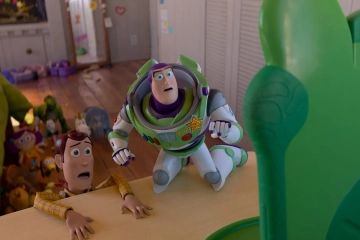
Woody’s return gives the movie its strongest emotional link to the earlier chapters. Tom Hanks brings back that familiar mix of warmth, nervous energy, leadership, and quiet melancholy. I liked seeing Woody from this later stage of his life, because he is no longer the same sheriff who once panicked over Buzz taking his place. He has already learned that love means letting go, but Toy Story 5 asks whether letting go becomes harder when the entire idea of play seems to be changing.
What works about Woody here is that he understands the ache of being left behind better than anyone. He has lived through Andy growing up. He has watched Bonnie’s attention shift. He has chosen a life outside the usual child-and-toy structure. That makes his perspective valuable when the gang faces Lilypad. Woody is not only trying to save playtime. He is trying to understand what toys are for when childhood itself feels different from the world he knew.
Buzz Lightyear Still Believes in the Mission
Buzz remains one of the franchise’s funniest and most dependable figures because he approaches every crisis with dramatic seriousness. Tim Allen’s voice performance keeps that heroic rhythm alive, even when the situation is absurd. I enjoy how Buzz can make a living room problem sound like an intergalactic operation. In Toy Story 5, that quality fits perfectly because the toys are facing a threat that feels almost impossible to fight directly.
The screen problem is not a villain Buzz can simply outmaneuver with a space-ranger plan. Lilypad captures attention in a way Buzz does not fully understand. That makes him funny, but also vulnerable. He has always been built around purpose, and this story questions what purpose means when a child no longer reaches for him first. Buzz’s confidence becomes touching because it is tested by something that does not follow the rules of old play.
Jessie Becomes the Emotional Leader of Bonnie’s Room
Jessie has one of the most interesting positions in Toy Story 5 because she knows the pain of abandonment deeply. Joan Cusack’s performance has always carried bright energy with sadness underneath, and that mixture matters here. Jessie understands what it means to wait for a child who may not come back. When Bonnie’s attention moves toward Lilypad, Jessie’s fear feels especially sharp.
I liked how the film treats Jessie not only as comic energy, but as someone with real emotional authority. She has been through the trauma of being forgotten, and that history gives her urgency. She does not want the toys to fade quietly into the background. She wants to fight for the kind of imaginative play that made them feel alive in the first place. Her leadership feels personal, not abstract.
Lilypad Is a Smart New Rival Because She Is Not Just Mean
Lilypad is a clever addition because she is not only a shiny device placed in the story to be mocked. Voiced by Greta Lee, she has her own logic about what is best for Bonnie. I liked that approach because it makes the conflict more interesting. A tablet can entertain, teach, distract, comfort, and absorb attention all at once. That complexity gives Lilypad more texture than a simple antagonist.
What makes her disruptive is that she does not need to chase the toys around the room to threaten them. She only needs to be appealing. She has games, colors, sounds, responses, and endless novelty. The toys are physical companions, but Lilypad is designed to keep attention flowing. That makes the conflict painfully modern. The question is not whether Lilypad is evil. The question is whether the toys still have a place when play becomes digital, immediate, and controlled by a screen.
Bonnie’s Room Feels Different This Time
Bonnie’s room has always been a warm, colorful space full of possibility, but Toy Story 5 changes the atmosphere. The room is still full of familiar faces, soft textures, shelves, boxes, and play corners, yet the glow of Lilypad changes where the emotional center sits. I liked how the film makes that shift visible. A room can be full of toys and still feel strangely quiet if the child’s attention has moved elsewhere.
This setting gives the movie a more intimate sadness than a big external adventure would have. The toys do not need to travel far to feel lost. They can feel lost right beside Bonnie. That is one of the most Toy Story ideas imaginable. The deepest fear is not danger in a faraway place. It is being close enough to be chosen, but watching the child choose something else.
The Animation Finds Comedy in Old Toys Meeting New Tech
The visual comedy of Toy Story 5 works best when the toys try to understand Lilypad through their own limited experiences. I enjoyed the contrast between their physical, handmade, plastic, plush, stitched, and spring-loaded bodies and the smooth responsiveness of a tablet. The toys belong to a world of touch, imagination, and pretend voices. Lilypad belongs to taps, swipes, animations, and instant feedback.
Pixar’s animation has always been excellent at making objects feel emotionally alive, and this film uses that skill in a fresh way. The toys’ faces, body language, and tiny reactions make their confusion funny and sad at once. A glowing screen can be visually simple, so the film has to make the emotional contrast carry the scene. It works when the toys’ physical presence feels warm against Lilypad’s sleek brightness.
The Theme of Screen Time Feels Personal for Parents and Children
The film’s screen-time theme is direct, but it feels relevant because it touches everyday family life. Children do use tablets. Parents do struggle with boundaries. Toys do sit unused. I liked that Toy Story 5 enters that familiar tension through the emotional viewpoint of the toys. The result is not a lecture, but a playful way to ask what kind of attention children need.
What I appreciated is that the movie does not have to claim all technology is bad to make its point. The stronger idea is about balance. Digital play can be exciting, but it can also narrow the space for open-ended imagination. A toy does not tell a child exactly what to do next. A toy waits for the child to invent. That waiting is part of the magic, and the film understands why losing it would matter.
The Old Gang Still Brings Comfort
Part of the pleasure of Toy Story 5 is simply spending time with these characters again. Woody, Buzz, Jessie, Rex, Hamm, Slinky, Bullseye, Forky, and the rest of the group carry decades of emotional history. I liked how their presence gives the film a built-in warmth. Even before the story fully begins, seeing them together creates a feeling of returning to a room I remember.
The challenge for any fifth film is avoiding the sense that everyone has been brought back only because audiences recognize them. Toy Story 5 works best when the old characters are tied to the new theme. Rex’s nervousness, Hamm’s sarcasm, Forky’s odd innocence, Buzz’s mission mode, Jessie’s fear, and Woody’s wisdom all react differently to the tech problem. That makes the ensemble feel useful rather than decorative.
Forky Still Makes Existence Sound Ridiculous
Forky remains a funny part of the later Toy Story world because he makes the basic rules of the franchise seem strange again. A handmade spork with googly eyes asking big questions about being alive is exactly the kind of absurdity Pixar can make emotional. I liked how Forky’s presence fits the screen-time theme in an odd way. He is the opposite of polished technology.
Forky exists because a child made him important. He is not advanced, expensive, responsive, or sleek. He is messy, simple, and meaningful because Bonnie imagined him into value. That makes him one of the strongest quiet arguments against Lilypad’s dominance. Forky reminds me that play does not need perfection. Sometimes it needs a few craft supplies, a child’s attention, and a willingness to believe something ordinary has become a friend.
The Humor Works Best When It Comes From Toy Logic
The comedy in Toy Story 5 is strongest when the toys misunderstand the modern world in ways that make sense for them. I enjoy when Buzz treats tech as a mission threat, Rex panics over impossible instructions, Hamm comments from the side with dry disbelief, and Woody tries to organize chaos while clearly knowing chaos is already winning. The humor feels natural because it grows from character.
The film also finds good physical comedy in scale. Tablets are normal to humans, but to toys they are large, glowing, mysterious objects with strange rules. Cords, cases, charging ports, icons, notifications, and screen reflections can become obstacles or clues. Toy Story has always been good at turning ordinary household objects into adventure terrain, and the tech setting gives that tradition new material.
The Aesthetics Balance Nostalgia and Digital Glow
Visually, the film creates a strong contrast between the warm textures of toys and the clean light of technology. I liked the way old plastic, fabric, stitching, paint, dust, cardboard, and wooden furniture sit against Lilypad’s smooth surface and shifting screen colors. That contrast is not only visual. It is emotional. The toys feel handled, worn, and loved. The tablet feels new, bright, and endlessly available.
Pixar’s style has become so polished that the smallest material details matter. A scratch on Woody, the fuzz on Jessie’s hat, the shine on Buzz’s suit, or the handmade awkwardness of Forky all carry history. Lilypad’s design has a different kind of appeal: clean, cute, responsive, and modern. The film’s best images place those two worlds close together and let the audience feel the difference without overexplaining it.
The Story Understands That Relevance Is a Painful Question
What makes Toy Story 5 more than a tech joke is the emotional question underneath: what happens when your purpose depends on someone else needing you? Every Toy Story film has asked a version of this, but the fifth film gives it a modern twist. The toys are not only worried about one child growing up. They are worried that children as a whole may be changing how they play.
I found that idea surprisingly tender. A toy’s identity is built around being played with. Without that, the toy still exists, but the meaning becomes uncertain. Woody has faced this before, yet seeing the whole group face it together gives the film a communal sadness. They are not fighting for attention out of vanity. They are fighting for the emotional space where imagination, care, and companionship happen.
The Music Brings Back the Franchise’s Gentle Ache
Randy Newman’s return gives the film a familiar musical soul. I like how Toy Story music can sound simple and still carry enormous feeling. A melody can make a bedroom feel like a whole childhood. A soft phrase can make a toy’s expression suddenly painful. The score helps the film stay connected to the emotional language of the earlier chapters.
The music matters especially because Toy Story 5 is about change. The franchise has always used songs and score to hold nostalgia without freezing the story in place. Here, the music can remind me of Andy, Bonnie, old playrooms, moving boxes, farewells, and new beginnings, while still making room for the digital-age theme. That blend of memory and uncertainty is exactly what the movie needs.
Why the Tech Conflict Fits the Franchise
The tech conflict works because Toy Story has always been about objects trying to understand human change. In the first film, Buzz changed Woody’s place in Andy’s room. Later films explored replacement, donation, daycare, lost toys, and the bittersweet freedom of life beyond one child. A tablet is simply the next step in that long emotional pattern.
What I like is that the film does not have to abandon the franchise’s classic feelings to address something new. The toys still hide when humans enter. They still panic, plan, argue, and improvise. They still want their child to be happy, even when that happiness hurts them. That is the Toy Story formula at its strongest: comedy on the surface, existential dread under the rug, and love somehow holding everything together.
The Best Moments Are Quietly Painful
For me, the most memorable scenes are not necessarily the biggest set pieces. They are the moments when a toy watches Bonnie choose Lilypad instead. That simple image carries decades of Toy Story emotion. A child does not mean to hurt a toy by not playing with it. She is simply growing, changing, and responding to what captures her attention. That innocence makes the pain sharper.
The film understands that heartbreak can be small. A toy left on the floor. A hand reaching past an old favorite. A room glowing blue while the toy box sits unopened. These images work because they connect to a universal feeling: being near someone you love while sensing that their world has moved slightly away from you.
Playtime Becomes a Defense of Imagination
The film’s strongest idea is that playtime is not only entertainment. It is a form of imagination where children practice emotion, story, conflict, care, and identity. Toys matter because they leave room for the child to complete the world. A cowboy can become a hero, a dinosaur can become brave, a spork can become a friend, and a bedroom can become a universe.
Lilypad challenges that because digital play often arrives already filled with instructions, images, sounds, and rewards. That can be exciting, but it can also reduce the need to invent from scratch. Toy Story 5 works when it defends the slower, stranger, more open kind of play without sounding bitter. The toys are not asking Bonnie to reject the future. They are asking not to lose the part of childhood that begins with pretending.
The Fifth Chapter Finds Emotion in Being Almost Obsolete
Toy Story 5 is most effective when it allows the toys to feel almost obsolete without making them pathetic. They are older icons in a newer world, and that is a delicate position. The film treats them with affection, humor, and respect. Woody, Buzz, Jessie, and the gang still have comic timing, courage, and emotional intelligence, but they also have to admit that love does not guarantee permanent attention.
That is a mature place for the franchise to go. The toys have always had to love children who will eventually leave them behind. Now they face a world where leaving behind may happen earlier, faster, and with a glowing device in hand. The sadness is real, but so is the hope. Imagination has survived many changes before. The film’s warmest belief is that toys may need to adapt, but the need for stories, touch, companionship, and make-believe is not gone. It is waiting for someone to look up from the screen and reach into the toy box again.