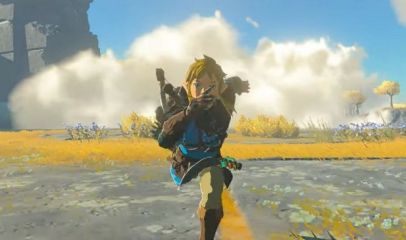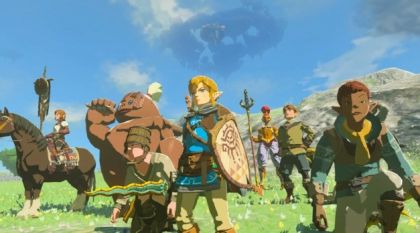
I came to The Legend of Zelda: Tears of the Kingdom expecting a grand return to Hyrule, but what I found felt less like a sequel and more like a vast mechanical daydream that somehow trusted me to become its co-author. It did not simply hand me a larger map and ask me to repeat old habits. It gave me strange tools, impossible geography, fragile machines, awkward experiments, and moments where I laughed at my own bad engineering before suddenly feeling like a genius five minutes later.
What impressed me most was how personal the adventure became. My path through Hyrule rarely felt like the one the game had prepared in advance. I built odd vehicles, climbed toward suspicious shapes in the distance, wandered into caves for no good reason, and spent too much time attaching objects together just to see if physics would allow my ridiculous idea to survive. Tears of the Kingdom made curiosity feel productive, even when my plans collapsed in the most undignified way possible.
A Hyrule That Feels Rebuilt From Wonder
The world is familiar, but it is not comfortable in a lazy way. Hyrule returns with recognizable landmarks, towns, fields, ruins, mountains, and weather patterns, yet the game rearranges my relationship with every part of it. The sky islands above turn vertical space into temptation. The underground regions below bring a darker, stranger rhythm. The surface becomes a middle layer in a much larger design, and I constantly felt pulled in three directions at once.
The aesthetics work because they mix ancient mystery with handmade invention. Floating ruins carry a quiet, sacred feeling, while wooden wheels, fans, rockets, wings, and gliders make the world feel like an open-air workshop. One moment I was admiring golden light over the clouds; the next, I was standing beside a horrifying vehicle I had assembled from scraps, pretending it was elegant. That contrast gives the game its unique personality.
There is also a softness to the visual style that makes exploration easy to live inside. The colors are warm without becoming sugary, the landscapes are readable without feeling plain, and the art direction lets every biome hold a distinct mood. Snowy cliffs, stormy skies, glowing underground paths, and grassy plains all feel connected by the same mythic atmosphere.
The Joy of Building Bad Ideas Until They Work
Ultrahand changed the way I played. At first, I treated it like a puzzle-solving tool. Then I realized it was closer to a permission slip. The game lets me connect objects, rotate parts, create platforms, assemble carts, repair bridges, build flying machines, and invent contraptions that look entirely unsafe. Many of my creations failed. Some flipped over. Some drifted away without me. Some worked for exactly three seconds, which, in fairness, was sometimes enough.
The genius is that failure rarely feels punishing. It feels funny, educational, and strangely motivating. I would look at a broken machine and immediately understand what I wanted to try next. Add another fan. Shift the weight. Use a stabilizer. Place the wheel differently. Try a rocket, then regret the rocket, then use two rockets because apparently I learned nothing.
This freedom reshapes combat, traversal, and puzzle solving. I was not just solving what the designers placed in front of me; I was negotiating with the game’s physical logic. That made small victories feel earned. Reaching a ledge with a poorly balanced aircraft felt as satisfying as clearing a major dungeon because it was my terrible little aircraft, and it somehow carried me to glory.
Link Feels Like an Adventurer and an Inventor
Link remains quiet, but in Tears of the Kingdom his silence makes even more sense because the player’s actions become his personality. My Link was brave, impatient, easily distracted, and dangerously overconfident with construction materials. The game never forced that interpretation; it emerged from how I played.
His abilities give him an unusually tactile relationship with the world. Ultrahand lets him reshape objects. Fuse lets him combine weapons and materials into strange new forms. Ascend allows him to move through ceilings and rethink architecture. Recall turns motion into a resource. Each ability feels distinct, but together they create a version of Link who is not just exploring ruins. He is reading the world as a system of possibilities.
Fuse deserves special praise because it makes ordinary loot feel exciting. A basic weapon becomes more interesting when paired with monster parts, stones, elemental materials, or odd items found in the environment. I began viewing my inventory less like a storage menu and more like a box of improvisational solutions. That gave even routine encounters a playful edge.
Zelda’s Presence Gives the Story Its Pull
Zelda is not simply an objective marker or a distant royal figure here. Her role gives the story an emotional shape that quietly builds through memories, discoveries, and the larger mystery surrounding Hyrule’s past. I found the narrative more effective when I let it come to me through exploration rather than rushing directly toward answers.
The story carries a sense of loss, duty, and time that suits the game’s scale. It is not always loud. Some of its strongest moments are solemn and reflective, especially when the game connects ancient events to the present. Zelda’s presence hangs over the adventure in a way that makes the world feel haunted by choices already made and sacrifices still unfolding.
Ganondorf brings a heavier mythic pressure to the game. His role adds darkness and threat without taking away the open-ended spirit of exploration. I liked that the game can move from silly construction experiments to grand fantasy drama without the tonal shift feeling broken. That balance is difficult, and Tears of the Kingdom manages it better than I expected.
The Dungeons Have Personality Again
The major temples feel more memorable than I anticipated. They are not a full return to older Zelda dungeon design in every respect, but they offer stronger identities, clearer themes, and more dramatic buildup than the Divine Beasts did for me. Each one feels connected to its region and its people, which gives the journey toward it a sense of narrative momentum.
I enjoyed how the companion characters are woven into these sections. Their abilities support exploration and combat, but their presence also makes regional stories feel less isolated. The people of Hyrule are not just waiting for Link to solve everything alone. They are involved, worried, hopeful, and sometimes surprisingly funny.
The temple structure also benefits from the new powers. Instead of hunting for a single intended route, I often found myself asking whether my solution was clever, reckless, or both. That flexibility can make some puzzles easier to bypass, but I rarely minded. The game seems comfortable with the idea that players will outsmart it in strange ways.
Combat Rewards Preparation and Mischief
Combat in Tears of the Kingdom is at its best when I treated it as a sandbox rather than a test of reflexes alone. Positioning, materials, fused weapons, elemental effects, devices, and terrain all matter. I could approach danger directly, but the game often rewarded a more creative plan.
I liked setting up advantages before a fight: preparing arrows with useful attachments, choosing weapons with specific fused parts, or using nearby objects to create a little chaos. The enemy variety encourages this because different situations call for different tools. A flying enemy, a heavily armored foe, and a clustered camp all invite different responses.
The weapon durability system still asks for patience. I understand why it exists, because it pushes experimentation and keeps the inventory moving. Even so, there were moments when I wished a favorite weapon could stay with me longer. Fuse softens that frustration by making replacements more interesting, but the system may still test players who prefer permanent gear.
The Underground Adds Unease to the Adventure
The Depths surprised me. They are eerie, vast, and deliberately uncomfortable. Moving through them changed my pace. On the surface, I often sprinted toward whatever caught my eye. Underground, I moved more carefully, watching the darkness and searching for light sources. The environment feels hostile without becoming monotonous, and that makes each discovery feel valuable.
What I appreciate most is how the Depths mirror and distort the surface. They are not just extra space. They create a second logic beneath Hyrule, one that rewards mapping, patience, and resource management. The darkness makes navigation feel physical. I had to earn visibility, and that made the world feel more dangerous.
This layer also gives the game a stronger sense of scale. Hyrule is not merely wide. It has height, depth, history, and secrets stacked on top of one another. The result is a world that feels almost absurdly generous, but rarely empty.
Small Discoveries Make the World Feel Alive
Some of my favorite moments had nothing to do with major quests. I helped strange little Koroks reach their friends. I followed rumors. I cooked questionable meals. I wandered into caves because a wall looked suspicious. I found odd armor pieces and immediately changed my outfit for no practical reason beyond style. The game understands that adventure is often made from detours.
Hyrule’s towns and side characters bring warmth to the scale. Stable workers, researchers, travelers, merchants, and villagers all help the world feel inhabited rather than merely designed. Their problems are sometimes small, but that is part of the appeal. After exploring floating ruins and gloomy depths, helping someone with a local issue can feel pleasantly grounding.
The sound design supports this beautifully. Soft piano notes, environmental sounds, mechanical hums, weather, distant creatures, and quiet musical cues make the world feel spacious. The soundtrack does not constantly demand attention. It leaves room for wandering, which makes the bigger musical moments land with more force.
What Stayed With Me While Playing
Tears of the Kingdom gave me a kind of freedom that felt both generous and slightly mischievous. It trusted me with powerful tools, then allowed me to create elegant solutions, messy shortcuts, and total nonsense. That trust made the game feel alive in a way few open-world adventures manage.
I also appreciated how it respects different play styles. A player can focus on story, construction, combat, exploration, shrines, armor collecting, cooking, side quests, or pure experimentation. I shifted between all of these depending on my mood, and the game rarely made me feel like I was playing incorrectly.
Its greatest strength is not just size. Many games are large. Tears of the Kingdom feels responsive. It notices my curiosity and gives it somewhere to go. It turns cliffs into questions, ruins into invitations, objects into tools, and mistakes into stories I actually want to remember.