A Red-and-White Hat Walks Into a Moving Day
I watched The Cat In The Hat with the feeling that this story works best when chaos arrives at exactly the wrong moment. The children are not in a grand fantasy kingdom or a superhero city. They are dealing with something ordinary and emotionally heavy: a move, a new town, unfamiliar rooms, and the uncomfortable feeling that home has become unstable. That makes the Cat’s arrival more than a random burst of nonsense. He enters when imagination is needed most.
What I liked about this version is that it treats the Cat as a strange professional of joy. He is not only a mischievous visitor who appears to cause trouble while the adults are away. He feels like someone with a mission, even if his methods are wildly questionable. That gives the movie a fun emotional angle. The Cat wants to help, but helping through chaos means every good intention may come wrapped in disaster, rhymes, impossible objects, and a hat that seems larger on the inside than any reasonable hat should be.
The Cat Is Mischief With a Job Description
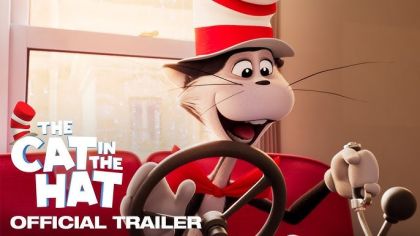
Bill Hader’s Cat has the perfect kind of vocal energy for a character who should sound charming, clever, slightly theatrical, and always one step away from creating a problem he will later describe as part of the plan. I liked that this Cat feels playful without losing the odd elegance of the original Dr. Seuss figure. He is silly, but not empty. He carries himself like a performer who believes every room can become a stage.
The Cat works because he is both helpful and impossible. He sees sadness, boredom, fear, or emotional stiffness and responds with imagination at maximum volume. That is a risky cure. His games can become too big, his confidence can outrun his judgment, and his sense of timing is not always connected to reality. Still, I found him appealing because he genuinely seems to believe that wonder can repair something inside the children. His troublemaking has a heartbeat.
Gabby and Sebastian Give the Story a More Emotional Shape
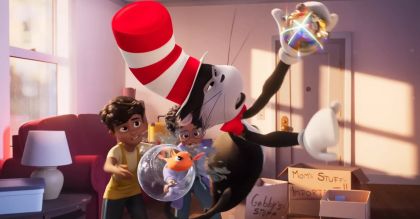
The siblings at the center of the movie give the Cat something real to respond to. Gabby and Sebastian are not only children stuck inside on a dull day. They are adjusting to change, which makes the story more emotionally active. I liked that choice because moving can feel enormous when you are young. A new house may look like walls and boxes to adults, but to children it can feel like the old world has vanished overnight.
Gabby brings the older-sibling tension of trying to manage feelings while pretending everything is fine. Sebastian carries the softer uncertainty of someone who needs reassurance but may not know how to ask for it clearly. Their different reactions make the Cat’s assignment more complicated. He cannot simply entertain them. He has to help them rediscover play when their emotional footing has shifted.
The Fish Is the Voice of Reason Nobody Wants to Hear
The Fish remains one of the best comic ideas in the Cat in the Hat world because he represents responsibility in a story designed to ignore responsibility for as long as possible. I enjoyed how he functions as the anxious moral center, constantly aware that disaster is building while everyone else is distracted by spectacle. A fish in a bowl should not have to supervise a magical intruder, but that is exactly why the joke works.
Matt Berry’s voice fits this kind of character beautifully because he can make panic sound formal, offended, and strangely grand. The Fish is not wrong. That is what makes him funny. The Cat really is too much. The house really is at risk of becoming a circus of nonsense. The children really should be careful. Yet the Fish’s caution also makes the Cat’s wildness feel more exciting. Their contrast gives the movie a strong comic rhythm.
The Things Multiply the Chaos
Thing One and Thing Two have always worked because they are pure trouble in matching outfits. This version expands that idea with even more Things, which feels both absurd and perfectly logical in a Dr. Seuss universe. I liked how the Things represent chaos without explanation. They do not need deep motives. They are movement, noise, speed, and disorder given tiny bodies and bright hair.
Their presence lets the animation become more physical and elastic. They can run, spin, stack, toss, leap, rearrange objects, and turn an ordinary room into a visual storm. What makes them fun is that they are not malicious. They are simply impossible to contain. The Cat may present them as helpers, but their idea of helping seems dangerously close to transforming every surface into a playground.
The Aesthetics Try to Think Like Dr. Seuss
The visual style is one of the most important parts of any Cat in the Hat adaptation. This world cannot look too normal. It needs curves, strange proportions, playful architecture, soft absurdity, and colors that feel slightly brighter than real life. I liked when the movie leaned into shapes that seem drawn from a child’s imagination rather than a practical design manual.
The Cat himself has to feel like he stepped out of a picture book and into a more modern animated world without losing his original silhouette. The tall striped hat, red bow, black body, white face, and long limbs remain instantly readable. That clarity matters. Around him, the world can bend, stretch, and shift, but the Cat’s design must remain iconic. The movie works best when every frame feels like a rhyme turned into architecture.
The Three Animation Modes Give Imagination Different Textures
One of the most interesting ideas is the use of different animation styles to separate the Cat’s whimsical world, the real world, and the children’s memories. I liked this because it gives the story a visual way to explore emotion. A child’s memory should not look exactly like a living room. The Cat’s imagination should not obey the same rules as a moving box or a kitchen table.
This layered style helps the movie feel less flat. The real world can carry the dull ache of change. The memory spaces can feel softer, more personal, and slightly fragile. The Cat’s world can be louder, bouncier, and more unpredictable. When these visual languages collide, the movie turns emotional confusion into design. That feels right for Dr. Seuss, whose stories often make feelings visible through impossible images.
The House Becomes a Playground and a Pressure Cooker
The house setting is important because it gives the chaos boundaries. A Cat in the Hat story needs walls, doors, stairs, furniture, boxes, and breakable order. The fun comes from watching the ordinary become unstable. I liked how a moving-day house adds extra potential for comedy. Boxes are already everywhere. Rooms are not settled. Objects do not yet belong where they are. The Cat arrives in a space that is already halfway between home and confusion.
That setting also supports the emotional theme. The children are not sure how to feel about the new place, so the Cat turns the house into a laboratory of imagination. A room that feels strange can become exciting. A hallway can become a route into nonsense. A pile of boxes can become something else entirely. The Cat’s chaos is messy, but it also helps the children start making the house emotionally theirs.
The Humor Works Best When It Sounds Like a Rhyme Escaped
The comedy in The Cat In The Hat needs a specific rhythm. It cannot feel only like ordinary cartoon jokes. It has to feel verbal, visual, and slightly musical, as if a rhyme has escaped its page and is now rearranging furniture. I liked the moments where the dialogue had bounce, where the Cat’s confidence made no sense but still sounded persuasive, and where the Fish’s objections grew increasingly desperate.
The best jokes come from escalation. A small game becomes a bigger game. A small mess becomes a larger mess. A simple attempt to cheer someone up becomes a full-scale imagination emergency. That structure fits the original story’s appeal. The Cat always seems to believe he is in control, while the audience can clearly see control slipping away in increasingly colorful ways.
The Cat’s Confidence Is Both His Gift and His Problem
The Cat is charming because he never doubts the value of fun. That confidence is infectious. I liked how he looks at sadness or boredom and treats it as a challenge to be solved through performance, surprise, and invention. He refuses to let a gray mood remain gray for long. That makes him a wonderful character for children who feel stuck inside their own worry.
But his confidence is also dangerous. He assumes that imagination can fix everything quickly, and the movie becomes more interesting when it questions that. Gabby and Sebastian do not only need distraction. They need emotional adjustment. They need to feel heard. The Cat’s growth, if he has one, comes from learning that cheering someone up is not the same as burying their feelings under noise. Real joy has to leave room for the sadness it interrupts.
The Moving Theme Makes the Story Feel Modern
The decision to build the story around siblings moving to a new town gives the movie a stronger modern frame. Many children understand the anxiety of change: new schools, new rooms, new neighbors, and the fear that old friendships or old routines may disappear. I liked that the movie uses a classic character to address that feeling in a playful way.
The Cat becomes a guide through emotional displacement. He does not explain change calmly like a school counselor with a clipboard. He makes change ridiculous, musical, messy, and imaginative. That approach suits him. He helps the children see that a new place does not have to remain empty or cold. It can be filled with stories, games, mistakes, and memories that have not happened yet.
The Voice Cast Adds a Big Comedic Texture
The supporting voice cast gives the film a lively ensemble feeling. Xochitl Gomez and Tiago Martinez help ground Gabby and Sebastian emotionally, while Matt Berry’s Fish adds fussy comic resistance. Quinta Brunson, Bowen Yang, Paula Pell, Giancarlo Esposito, and other voices add extra flavor to the larger world around the Cat. I liked the sense that this adaptation is not afraid to expand the universe beyond one rainy-day room.
The risk with a large cast is that the story can become too crowded, especially when the Cat already brings enough personality for three movies. The film works best when every new character supports the central emotional mission. If someone adds a new kind of joke, a new rule of the Cat’s world, or a new obstacle to the children’s adjustment, they fit. If not, the Cat’s hat starts to feel a little overpacked.
The Seussiverse Idea Gives the Film Extra Pressure
Because this movie is positioned as the beginning of a larger animated Seuss universe, it carries extra pressure. I felt that while watching. The Cat In The Hat cannot only introduce its own story; it also has to suggest that this visual and comic world can support more adventures. That is a tricky balance. Too much setup can make a simple story feel like a business plan wearing a bow tie.
The film is strongest when it focuses on the Cat, the children, the Fish, the Things, and the emotional problem of the move. The wider universe can wait in the corners. Dr. Seuss stories work because they are specific, rhythmic, and strange in compact ways. A shared universe may be exciting, but the Cat should never feel like he is pausing his nonsense to advertise the next book on the shelf.
The Music and Sound Need to Bounce Without Becoming Too Loud
The sound of this world matters almost as much as the look. The Cat’s steps, the Things’ movement, the Fish’s bowl, the hat’s magic, the shifting rooms, and the sudden bursts of activity all need a playful soundscape. I liked when the sound design felt springy and physical, as if every object had comic potential.
Music can also help the movie capture the Seuss rhythm. The score works best when it feels nimble, curious, and slightly off-balance. It should not simply push emotion too heavily. This is a world where nonsense has tempo. A chase can feel like a percussion exercise. A quiet memory can soften the colors. A Cat entrance should sound like trouble has just learned choreography.
The Best Moments Keep the Cat Strange
What I appreciated most is when the movie lets the Cat remain odd. There is always a temptation to overexplain classic characters, especially in modern adaptations. But the Cat should not become too ordinary or too psychologically neat. He is a visitor from imagination, a rule-breaker with manners, a helper who causes messes, and a performer who may not fully understand where performance ends.
The movie gives him a mission, which adds structure, but he still needs mystery. I liked when he seemed larger than the plot around him, as if his hat might contain other stories, failed assignments, secret rooms, and emotional tools disguised as nonsense. The Cat should feel knowable enough to love and unknowable enough to remain magical. That balance is delicate, but essential.
The Children’s Sadness Gives the Nonsense a Reason
The emotional foundation of the film is the siblings’ adjustment to a new life. Without that, the chaos would be fun but lighter. With it, every ridiculous invention has a reason to exist. The Cat is not simply filling time. He is trying, in his sideways way, to help children feel less trapped by change. I liked that because it gives the nonsense a purpose.
The film understands that children do not always need perfect advice. Sometimes they need play that helps them approach a feeling indirectly. A joke can create breathing room. A wild game can turn fear into movement. A messy room can become proof that the new house is no longer untouched and strange. The Cat’s methods are absurd, but the need underneath them is real.
The Hat Is Still the Best Symbol
The tall striped hat remains the perfect symbol for the character because it is funny before it does anything. It is too tall, too formal, too recognizable, and somehow completely confident. I liked how the film treats the hat almost like a source of possibility. It is costume, tool, portal, identity, and promise all at once.
The hat also captures the Cat’s contradiction. It makes him look like a gentleman, but everything he does challenges order. He arrives dressed for presentation and immediately turns the room into a circus of imagination. That contrast is the joke and the magic. The hat says, “Trust me,” while every event after his arrival says, “Maybe do not trust him completely.”
The Movie Works When It Respects Small Childhood Problems
The Cat In The Hat is most charming when it remembers that a child’s ordinary problem can feel enormous. Moving house, missing the old place, feeling unsure in a new room, or watching a sibling handle change differently are not small experiences from inside childhood. They are huge. The film’s fantasy works because it takes those feelings seriously while answering them with nonsense instead of speeches.
I found the movie most appealing when its wildness stayed connected to that emotional scale. The Cat can bend reality, summon Things, create impossible games, and turn a house into a playground, but the point is still simple: two children need to feel less alone in a new chapter of life. That gives the story warmth under the stripes, the rhymes, the mess, and the magnificent confidence of a cat who may be the least sensible helper imaginable and somehow exactly the one the room needed.