A New Student Steps Into an Old Legacy
I watched Karate Kid: Legends with the feeling that this franchise has become less like a single story and more like a long conversation between generations. The movie does not arrive as a simple restart. It carries the memory of Daniel LaRusso, the discipline of Mr. Han, and the uncertainty of a new young hero who has to make sense of both. That mixture gives the film its main appeal. It is familiar enough to feel connected to the past, but different enough to let Li Fong stand at the center of his own struggle.
What I liked most is that the movie treats martial arts as more than tournament preparation. Yes, the story includes training, rivalry, pressure, and a final competitive goal, but the deeper focus is identity. Li is not only learning new techniques. He is trying to understand who he becomes after being pulled from one life into another. The film works best when it remembers that every stance, breath, and lesson is really about balance between grief, fear, pride, and belonging.
Li Fong Carries More Than Skill
Li Fong is interesting because he does not begin as an empty beginner. He already has ability, history, and discipline before the story brings him to New York. That choice gives the movie a different shape from the classic underdog formula. Li is not simply learning how to stand up for himself. He is learning how to adapt what he already knows to a world that does not immediately understand him.
Ben Wang gives Li a guarded energy that I found believable. He is quick, focused, and physically capable, but there is a sadness underneath his confidence. He has moved across cultures, lost the comfort of familiarity, and entered a city where his talent does not automatically give him peace. I liked that the film lets him feel displaced. His training is impressive, but it cannot solve loneliness by itself.
New York Gives the Story a Different Pulse
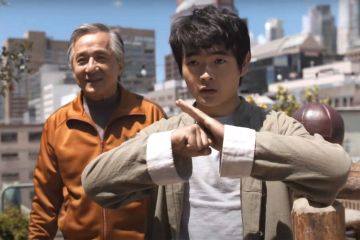
The New York setting changes the texture of the franchise in a useful way. The city has speed, noise, vertical space, crowded sidewalks, school pressure, neighborhood tension, and a constant feeling of movement. I enjoyed seeing martial arts placed against that environment. It makes Li’s journey feel less like a quiet retreat into tradition and more like a search for stillness inside a restless place.
The aesthetics of the city scenes are important because they contrast with Li’s internal discipline. New York feels busy, unpredictable, and socially sharp. Li has to read people as carefully as he reads movement. The film uses that contrast well. A school hallway, a rooftop, a training room, and a public street can all become spaces where he measures himself against new expectations. The city does not simply host the story. It tests his ability to remain centered.
Mr. Han Brings Patience With a Heavy Past
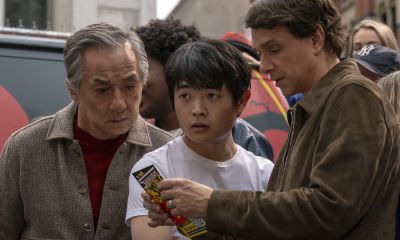
Jackie Chan’s Mr. Han gives the movie quiet authority. I liked that he does not need to dominate every scene to make his presence felt. He carries the weight of experience in small gestures, pauses, and looks. His teaching style has always been rooted in repetition, attention, and emotional restraint, and that approach still feels meaningful here.
What I appreciated is that Mr. Han does not treat Li’s talent as enough. He understands that skill without inner balance can become unstable. His lessons are not only about movement. They are about the mind that moves first. When he teaches, I sense that he is trying to protect Li from using pain as fuel without understanding where that pain leads. That gives their relationship a deeper charge than a simple coach-student dynamic.
Daniel LaRusso Connects the Film to Memory
Ralph Macchio’s Daniel LaRusso brings a different kind of legacy. He represents the original emotional language of the franchise: discipline, humility, patience, and the belief that martial arts should shape character before victory. I liked seeing Daniel enter this story not as a museum piece, but as someone whose own lessons still have purpose when applied to a new student.
Daniel’s presence works because he carries history without needing to explain every part of it. His name, posture, and calm approach bring the earlier films into the room. At the same time, the movie does not make Li disappear behind nostalgia. Daniel becomes part of Li’s education, not the owner of it. That balance matters. The franchise can honor the past only if the new hero is allowed to grow beyond being a tribute.
The Two Mentors Create the Film’s Best Tension
The partnership between Mr. Han and Daniel gives Karate Kid: Legends its most distinctive idea. They do not represent identical traditions. Their methods, backgrounds, and philosophies carry different rhythms. I liked the way the film uses them to show that wisdom can arrive through more than one path. Li does not receive a single answer. He receives a challenge to merge what he knows with what he still needs to learn.
This combination gives the training scenes extra meaning. The movie is not only asking whether Li can become stronger. It is asking whether two schools of thought can meet without losing their identity. That makes the physical preparation more engaging. Every correction, drill, and conversation becomes part of a larger question: how do you honor where you come from while adapting to what life now demands?
The Training Scenes Feel Best When They Slow Down
I enjoyed the training scenes most when the film allowed repetition to matter. Modern sports stories often rush through practice because they want to reach the tournament quickly, but Karate Kid stories have always depended on the beauty of slow learning. A small adjustment can change everything. A breath can reset the body. A simple motion can carry a lesson that takes time to understand.
The movie has enough energetic movement to satisfy, but its strongest training moments are not the loudest. I liked watching Li absorb corrections from both mentors, especially when the lesson seemed practical at first and emotional later. That is the classic strength of this series. The student thinks he is learning a technique, but the audience gradually realizes he is learning how to live with more clarity.
The Rivalry Has Social Pressure Beneath It
The local karate champion gives Li an external challenge, but what interested me more was the social pressure around that rivalry. Li is not only facing someone skilled. He is facing a new environment where reputation, belonging, and pride are all tangled together. The conflict works because it is tied to his need to find a place in a city that has not made room for him easily.
I liked that the tournament goal creates structure without becoming the whole emotional point. The competition matters, but it matters because of what it reveals. Li has to decide what he is defending, what he is proving, and whether victory alone can answer the questions he is carrying. The best parts of the rivalry are the moments when physical pressure exposes emotional confusion.
The Main Characters Give the Story Its Human Texture
The supporting characters help prevent Li’s journey from becoming isolated. His mother brings concern, grief, and protective urgency. I liked how her presence reminds me that Li’s choices affect more than his own pride. She sees danger in ways he may not want to acknowledge, and her fear is not unreasonable. That parent-child tension gives the story emotional weight.
Mia and Victor Lipani add another layer by connecting Li to ordinary life outside training. Through them, the movie gives him reasons to care about New York beyond conflict. I appreciated that because martial arts stories can sometimes become too focused on the dojo and the tournament. Li needs relationships that make the city feel personal. Without them, his growth would feel more like a technical upgrade than a lived experience.
The Aesthetics Blend Old Ritual and Modern Motion
Visually, the movie has an appealing contrast between tradition and urban speed. Training spaces carry a sense of discipline, while New York adds steel, glass, concrete, lights, and constant movement. I liked that the film does not make martial arts look detached from daily life. It places form and focus inside a modern setting where distraction is everywhere.
The costumes and physical staging also help define character. Li often seems caught between worlds, while Daniel and Mr. Han each carry a more settled sense of identity. The city’s visual pressure makes that difference clear. The movie’s best images are the ones where a quiet martial arts posture holds against the noise around it. Those moments make balance visible before anyone says the word.
The Action Works When Character Leads Movement
The martial arts sequences are most effective when they express personality. Li’s movement has speed and precision, but the film becomes more engaging when I can feel his emotional state inside that movement. When he is unsettled, the action should feel tense. When he begins to understand himself, it should feel clearer. The movie often finds that connection.
I appreciated that the action is not only about impact. It is about timing, control, footwork, and reaction. The best moments show that martial arts are not random bursts of force. They are decisions made through the body. That fits the franchise’s spirit. A student’s progress should be visible not only in winning exchanges, but in how he stands, listens, waits, and chooses.
The Legacy Theme Has Real Pressure
The title Legends could have made the movie feel trapped by its own history, but I think the film uses legacy in a meaningful way. Daniel and Mr. Han are not just famous faces returning for applause. They represent two lines of teaching that Li has to respect without becoming swallowed by them. That gives the movie a thoughtful center.
I liked that Li’s journey is not about replacing anyone. It is about becoming himself while standing near people whose names already carry weight. That is a difficult place for a young character. Too much reverence can freeze him. Too much rebellion can cut him off from wisdom. The film’s better scenes understand this tension and let Li search for a third path.
The Emotional Core Is Balance Under Pressure
Karate Kid: Legends works for me when it treats balance as something harder than a slogan. Balance is not only standing steady or combining styles. It is learning how to carry loss without being ruled by it, how to accept guidance without surrendering identity, and how to enter a new world without erasing the old one.
That idea gives the movie its strongest emotional shape. Li’s body may be trained, but his life is still uneven. He has to bring grief, anger, discipline, affection, and hope into one movement. When the film shows that process clearly, it feels connected to the best parts of the franchise. The story is not only about who stands tallest at the end of a match. It is about whether a young person can find enough inner steadiness to move forward without losing himself.