A Thousand Years Ahead and Still Painfully Human
I have always enjoyed Futurama because it uses the future as a joke machine first and a mirror second, then somehow makes both parts feel equally important. On the surface, it is an animated science fiction comedy about delivery workers, strange planets, robots, aliens, absurd inventions, and corporate nonsense in the 31st century. Under that bright layer, it is also a surprisingly sharp show about loneliness, work, friendship, regret, love, failure, and the ridiculous ways people try to feel important in a universe that is far too large to care.
What keeps the series fresh for me is the contrast between its huge setting and its very ordinary emotions. Futurama can travel across galaxies, visit bizarre civilizations, bend time, parody classic science fiction, and turn a mathematical idea into a punchline. Yet the emotional center often comes back to simple needs: Fry wants belonging, Leela wants identity and respect, Bender wants attention and freedom, and everyone at Planet Express wants to survive another strange day at a job that should have been illegal by lunch. That mix of cosmic scale and workplace exhaustion gives the show its unique flavor.
New New York Feels Like a City Built From Bad Decisions
The setting is one of the funniest parts of Futurama. New New York is futuristic, but not polished into a perfect utopia. It is messy, commercial, loud, careless, and full of systems that seem advanced only until someone has to use them. Tubes replace taxis, robots have their own culture, heads of historical figures live in jars, and aliens are treated with the same casual irritation people usually reserve for neighbors, coworkers, and slow service.
I like that the future in Futurama is not a clean dream. It is recognizably human, which means it is full of shortcuts, advertisements, bureaucracy, scams, class divisions, and deeply questionable technology. That makes the world feel funnier and more believable. The show understands that progress does not automatically make people wiser. It only gives them more complicated ways to be selfish, lazy, brilliant, romantic, and foolish.
Fry Is Funny Because He Never Fully Catches Up
Philip J. Fry works as the audience’s entry point because he is from the past, but he is not treated as a noble observer. He is confused, impulsive, kind, immature, and often impressively unprepared for everything around him. I enjoy him because he reacts to the future with wonder at first, then gradually with the same casual laziness he brought from the 20th century.
What makes Fry more than a simple comic lead is his emotional openness. He is not brilliant, but he is sincere. He often makes poor choices, but his feelings are rarely fake. His loneliness gives the show some of its most touching moments, especially when the story explores what he lost by being frozen in time. The future gives him adventure, but it also separates him from everyone he once knew. That sadness quietly follows him, even when the episode is full of absurd jokes.
Leela Brings Competence, Anger, and Vulnerability
Leela is the character who often keeps the story from floating away into pure nonsense. She is capable, disciplined, and usually the only person in the room with a working sense of responsibility. I like that the show lets her be strong without making her emotionally simple. Her confidence is real, but so is her loneliness. She wants to know where she comes from, who she belongs to, and whether her difference makes her special or isolated.
Her dynamic with Fry works because it is uneven in a believable way. Fry adores her, often clumsily, while Leela has to decide whether his sincerity can outweigh his foolishness. She is not there only to reward his persistence. She has her own standards, frustrations, ambitions, and fears. That gives their relationship more texture than a basic animated romance. It can be funny, awkward, tender, and irritating, sometimes within the same scene.
Bender Is a Bad Influence With Perfect Comic Timing
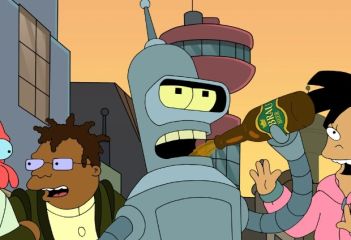
Bender might be the show’s most instantly memorable character because he turns selfishness into an art form. He lies, steals, drinks, insults, and complains with such confidence that I often laugh before the joke has fully landed. His voice, movement, and dramatic sense of personal importance make him feel like a walking factory of bad decisions.
Still, Bender works because he is not only a chaos device. The show occasionally reveals his insecurity, loyalty, vanity, and desire to be seen as more than a machine. He wants freedom, but he also wants applause. He wants independence, but he keeps returning to the people who tolerate him. That contradiction makes him funnier. He is awful in ways that are too exaggerated to feel realistic, but his need for recognition feels strangely familiar.
Planet Express Turns Work Into Cosmic Nonsense
The Planet Express crew gives Futurama its workplace-comedy backbone. I love the idea that a company capable of reaching distant planets still operates with terrible management, low safety standards, and employees who barely understand the mission before they are already in danger. The business model is absurd, but the office dynamics are recognizable.
Professor Farnsworth is reckless genius wrapped in old age and casual negligence. Hermes brings bureaucracy and procedure into situations that absolutely do not deserve paperwork. Amy adds wealth, carelessness, and surprising scientific ability. Zoidberg is pathetic, strange, and somehow lovable because his social failure is so complete that it becomes a form of innocence. Together, they make Planet Express feel like the worst possible workplace and the only family many of these characters have.
The Aesthetics Mix Retro Sci-Fi With Cartoon Dirt
Visually, Futurama has a style I find instantly comfortable. It borrows from classic science fiction imagery, but it keeps everything slightly goofy and lived in. Ships, robots, alien cities, laboratories, and futuristic gadgets have clean silhouettes, yet the world never feels sterile. There is grime, clutter, cheap signage, weird furniture, and background absurdity everywhere.
I especially like how the animation supports both comedy and worldbuilding. Character designs are simple enough for fast expressions, while the environments can become surprisingly imaginative. Alien planets have their own visual jokes. Futuristic machines often look both impressive and suspiciously impractical. The show’s aesthetic says a lot about its worldview: the future may be advanced, but it is still built by people who cut corners.
The Writing Is Smarter Than It Pretends to Be
One of my favorite things about Futurama is how casually intelligent it can be. The show often hides complex ideas inside ridiculous plots. It uses physics, mathematics, philosophy, science fiction history, and social satire without turning episodes into lectures. A joke might work as simple silliness, then reward viewers who understand the deeper reference.
That layered writing gives the series strong rewatch value. The first time, I might laugh at Bender being horrible or Fry misunderstanding something obvious. Later, I notice a background detail, a scientific concept, a literary reference, or a satirical angle I missed before. Futurama respects its audience enough to be strange and specific. It does not flatten every idea into the easiest possible version.
The Humor Can Be Cynical Without Feeling Empty
Futurama is often cynical about society, business, politics, media, technology, and human nature. It imagines a future where many problems have not disappeared; they have only changed costumes. Companies are still greedy, leaders are still foolish, entertainment is still ridiculous, and people still make selfish choices for extremely small rewards.
Yet the show does not feel empty to me. Its cynicism is balanced by affection for its characters. Fry may be foolish, but he is kind. Leela may be frustrated, but she cares. Bender may be deeply unreliable, but his attachment to the group still matters. The series laughs at human failure while admitting that connection can survive inside all that nonsense. That balance is why the humor has bite without becoming cold.
The Emotional Episodes Hit Harder Because the Show Usually Jokes
Some of Futurama’s most memorable moments come when the comedy suddenly opens into sadness. The show is famous for being funny, but its emotional episodes stay with me because they arrive without abandoning the series’ identity. It does not become a different show when it gets tender. It simply reveals the ache that was hiding underneath the jokes.
Fry’s past is especially powerful because it reminds me that time travel fantasies often ignore grief. He gets a future full of wonders, but he also loses a family, a home, and an entire era. Episodes that explore those losses carry real weight. The series understands that comedy and sadness can sit close together. Sometimes the funniest characters are funny because they are trying not to look too closely at what hurts.
The Science Fiction Parodies Come From Real Love
Futurama parodies science fiction constantly, but it rarely feels dismissive. I sense affection behind the jokes. The show understands the genre well enough to twist its ideas intelligently. Space travel, alien diplomacy, robot consciousness, time loops, parallel realities, genetic experiments, and impossible inventions all become comic material, but they are usually built on recognizable science fiction questions.
That is why the parody works for me. The writers are not simply pointing at genre clichés. They are playing with the machinery of science fiction from the inside. The show can mock a trope while still enjoying its imaginative potential. It gives me the pleasure of a space adventure and the pleasure of watching that adventure collapse under the weight of terrible decisions.
The Characters Age Emotionally Even When the Cartoon World Resets
Like many animated sitcoms, Futurama often returns to a familiar rhythm, but I still feel a sense of emotional accumulation. Fry and Leela’s relationship changes over time. Bender’s loyalty becomes more visible. The crew’s weird bond grows stronger because they repeatedly face impossible situations together. The world may reset in broad comic terms, yet the characters do not feel completely static.
I appreciate that gradual development. It makes the show feel more rewarding across seasons. The characters can remain funny because their flaws persist, but their relationships gain history. A joke between Fry and Bender means more after I have seen their friendship tested. Leela’s guardedness means more after I understand her past. Even Zoidberg’s loneliness becomes more than a running gag when the show gives him moments of dignity.
The Future Is Ridiculous Because People Are
The part of Futurama that stays with me most is its belief that technology will change everything except the basic absurdity of being alive. People will still want love, money, comfort, status, revenge, snacks, and attention. They will still misunderstand each other. They will still build amazing tools and use them for petty reasons. They will still dream of greatness while avoiding basic responsibility.
That idea gives the series its lasting charm. Futurama is not funny only because the future is strange. It is funny because the future is strange in ways that reveal the present. The show sends me to the 31st century, then keeps reminding me that humanity packed all its worst habits along with the luggage. I enjoy that honesty. The universe may be full of aliens, robots, and impossible science, but the most unpredictable creature in it is still a person trying to get through the day with dignity, appetite, and questionable judgment.