
A Christmas Comedy Powered by Total Sincerity
I return to Elf with the same surprised affection every time, because the film looks simple from a distance and turns out to be much more precise than it first appears. It is not only a comedy about a grown man in green tights wandering through New York City. It is a story about innocence colliding with cynicism, family arriving in an inconvenient form, and joy becoming almost rebellious in a world that keeps asking everyone to be practical.
What makes the movie work for me is that Buddy is never treated as a cruel joke. The film lets him be ridiculous, but it does not look down on him. His enthusiasm is oversized, his manners are strange, and his understanding of ordinary human behavior is extremely limited, yet his emotional instincts are often better than those of the people around him. He believes in celebration, honesty, sugar, songs, handmade gifts, and direct affection. In a colder movie, that would be mocked. In Elf, it becomes the force that changes the room.
Buddy Turns Naivety Into a Superpower
Buddy is one of Will Ferrell’s most memorable characters because he is played with complete commitment. I never feel that Ferrell is standing outside the character and winking at the audience. He behaves as if Buddy’s rules make perfect sense, and that is why the performance lands. Buddy does not know he is absurd. He knows he loves Christmas, misses his father, and wants to belong.
I like how the movie uses Buddy’s innocence to reveal how guarded everyone else has become. He says what he feels immediately. He trusts too quickly. He reacts to ordinary things with enormous wonder. A revolving door becomes an event. A department store becomes a place of sacred responsibility. A plate of spaghetti becomes a canvas for sugar-based experimentation. The humor comes from excess, but the warmth comes from the fact that Buddy’s feelings are real.
New York Looks Like the Exact Wrong Place for an Elf
The shift from the North Pole to New York City gives the film its strongest visual joke. Buddy is built for a world of candy-colored workshops, cheerful songs, tiny furniture, and open affection. New York is crowded, impatient, skeptical, and fast. I enjoy how the movie places his bright costume against gray sidewalks, office towers, department stores, and busy streets. He looks wildly out of place before he even speaks.
The city works because it is not shown as evil. It is simply tired. People are busy, distracted, and suspicious of anyone who behaves with too much wonder. That makes Buddy’s arrival feel disruptive in a funny and oddly hopeful way. He does not understand urban rules, but he does understand how to notice beauty. A city that seems ordinary to everyone else becomes magical through his eyes, whether he is admiring lights, greeting strangers, or treating a mailroom like a social club.
The North Pole Has Handmade Storybook Charm
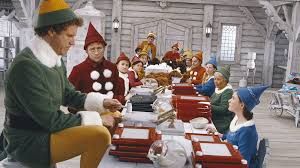
The North Pole scenes are charming because they feel deliberately old-fashioned. The sets have a playful, handcrafted quality that reminds me of classic holiday specials rather than sleek modern fantasy. I like that choice. It gives Buddy’s childhood world a storybook innocence, full of bright colors, cheerful work, and physical comedy.
The contrast in scale also adds to the humor. Buddy is far too large for the elf world, and the movie milks that visual mismatch without making it mean-spirited. His size is funny, but it also quietly explains his loneliness. He has been loved, yet he has never fully fit. That emotional detail matters. Before he ever reaches New York, the film shows that Buddy’s search for his father is also a search for a place where his body, heart, and identity make sense together.
Walter Hobbs Gives the Film Its Hard Edge
Walter Hobbs is essential because he represents the adult world at its least festive. He is impatient, status-conscious, emotionally distant, and so buried in work that he can barely recognize a miracle when it walks into his office wearing yellow tights. I like that he is not presented as a cartoon villain. He feels like a man who has allowed pressure and ambition to narrow his life.
His relationship with Buddy gives the movie emotional structure. Buddy wants a father. Walter wants efficiency. Buddy brings affection without strategy. Walter responds with suspicion and embarrassment. That contrast could have been one-note, but the film gradually lets Walter’s resistance reveal sadness rather than simple coldness. Watching him soften is satisfying because it does not happen instantly. Buddy has to become impossible to ignore.
Jovie Makes Cynicism Feel Understandable
Jovie is one of the film’s most important characters because she shows that guardedness can come from disappointment rather than cruelty. She works in a holiday environment, but she does not automatically feel holiday cheer. I found that believable. Being surrounded by decorations does not mean a person feels joyful. Sometimes it only makes the absence of joy more visible.
Zooey Deschanel gives Jovie a dry, gentle melancholy that balances Buddy’s constant brightness. Their connection works because Buddy does not try to impress her in a normal romantic way. He simply sees her, compliments her honestly, and invites her into his strange emotional weather. I like that she does not transform into a different person overnight. She opens gradually, and that makes her warmth feel earned.
The Comedy Is Loud, Physical, and Surprisingly Clean
Elf has plenty of broad comedy, but I think its timing is sharper than people sometimes remember. Buddy’s physical size, speed, appetite, and lack of social awareness create joke after joke, yet the film rarely feels random. Most of the humor comes from placing one completely sincere character in situations built on unspoken rules.
I laughed because Buddy misunderstands the world with such confidence. He does not break norms to be rebellious. He breaks them because he has never heard of them. That makes scenes in offices, stores, restaurants, and public spaces feel fresh. The comedy also has a strong rhythm: a small misunderstanding escalates, Buddy commits fully, and everyone else has to react to a level of enthusiasm they cannot manage.
The Aesthetics Mix Candy, Concrete, and Christmas Lights
The visual style of Elf is one of its quiet strengths. The North Pole is bright, cozy, and theatrical. New York is colder and more realistic, but the film gradually allows holiday color to seep into it. I like that movement. The city does not become magical all at once. Buddy decorates it emotionally first, then visually.
The costume design is especially effective. Buddy’s outfit is ridiculous in the real world, but it also functions like a flag. He carries his identity visibly, without shame. His green coat, yellow tights, pointed hat, and bright expression make him impossible to absorb into the background. That visual refusal to blend in becomes part of the movie’s message. Buddy is not trying to become normal. He is trying to remain himself while finding people who can love him that way.
Family Is Messy Before It Becomes Warm
The family story in Elf works because it begins awkwardly. Buddy does not arrive as a convenient blessing. He interrupts Walter’s office, marriage, reputation, and routine. Emily and Michael respond with more openness, but even they have to adjust to the shock of this enormous, innocent stranger entering their family. I liked that the movie lets that discomfort exist.
Michael gives Buddy a bridge into the household. Their bond is sweet because Michael recognizes Buddy’s strangeness without rejecting it. In some ways, Buddy helps Michael become bolder too. The family dynamic changes because Buddy brings emotional directness into a home that has grown too quiet around Walter’s priorities. He is not subtle, but subtlety is not what this family needs.
The Music Helps the Movie Glow Without Becoming Too Soft
The music in Elf gives the film a classic holiday texture without making it feel sleepy. The songs, score, and performance moments all support the idea that Christmas spirit is not just decoration. It is shared energy. I especially like how singing becomes a test of vulnerability. Characters who sing are not only making music; they are allowing themselves to participate in something that might look foolish from the outside.
That is why the musical moments matter emotionally. Buddy sings because joy naturally spills out of him. Jovie sings more cautiously, as if rediscovering a part of herself she has kept hidden. The crowd’s eventual participation feels broad, yes, but it fits the film’s emotional logic. In Elf, public cheer is awkward until enough people decide to risk looking uncool together.
The Film’s Sweetness Has More Bite Than It Seems
What keeps Elf from becoming sugary in the wrong way is its understanding that sincerity can be uncomfortable. Buddy’s honesty embarrasses people. His affection arrives too quickly. His joy exposes everyone else’s guarded habits. The movie is sweet, but it is not passive. It argues that kindness and enthusiasm require courage, especially in spaces where irony feels safer.
I enjoy that tension. Buddy is not wise in every practical sense, but he has emotional clarity. He knows when people are sad. He notices when celebration feels fake. He believes that work should not erase love. His worldview is simple, but the film uses that simplicity to challenge adult habits that are often treated as normal: distance, cynicism, overwork, and fear of embarrassment.
Why Buddy Still Feels Larger Than the Joke
The reason Elf remains so enjoyable for me is that Buddy is more than a funny costume and a loud voice. He is a character built around longing. He wants his father, but he also wants a world where affection can be expressed without shame. His journey is comic because he misunderstands so much, yet it is touching because his deepest need is easy to understand.
I find the movie most effective when it lets Buddy’s innocence create real consequences. He annoys people, disrupts routines, and causes chaos, but he also reminds them of what they have neglected. The film’s charm comes from that balance. It is silly enough to make a department store Santa confrontation feel like a major event, yet sincere enough to make a simple act of belief feel emotionally meaningful. Elf works because it treats Christmas not as a decoration, but as a test of whether people are willing to become a little less afraid of joy.