
A Supervillain Dad Trying to Keep His Balance
I watched Despicable Me 4 with the feeling that this franchise now lives in a very unusual place. It is no longer just the story of Gru learning how to care for three girls, and it is no longer only a playful comedy about gadgets, lairs, Minions, and exaggerated villain style. By this fourth main chapter, Gru has become something funnier and more complicated: a former villain, a working agent, a husband, and a father whose life keeps growing faster than his ability to control it.
What I enjoyed most is that the movie understands how absurd Gru’s domestic life has become. He can face dangerous enemies, operate strange technology, and handle secret missions, yet ordinary family pressure still finds ways to unsettle him. That contrast gives the film its comic engine. Gru may have experience with grand schemes and dramatic entrances, but a baby, a new neighborhood, school problems, and family identity challenges can still push him into panic. The movie works best when it places huge spy-movie energy beside small household chaos.
Gru Is Still Weird Enough to Be Funny
Gru remains the center of the film because his personality is such a strange mix of menace, awkwardness, tenderness, and insecurity. I like that he has changed over the series without becoming bland. He is more loving now, but he is still Gru. His voice, posture, dramatic seriousness, and strange social habits continue to make him feel distinct from the usual animated father figure.
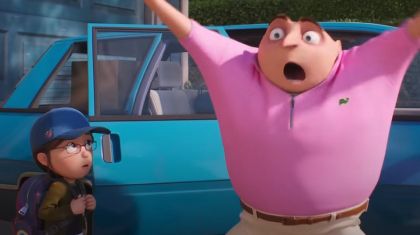
In Despicable Me 4, I found him especially entertaining when he tries to act normal. Gru is not built for suburban ease. He looks like someone who should be standing in a secret base, not blending into a quiet community. That mismatch creates some of the film’s best moments. He wants to protect his family and do the right thing, but he cannot fully erase the theatrical villain instincts that shaped him. Watching him force himself into ordinary situations gives the movie a fun, awkward rhythm.
Lucy Brings Speed, Nerves, and Warmth
Lucy continues to be one of the franchise’s best additions because she brings a completely different energy from Gru. She is quick, cheerful, intense, and often more openly expressive than he is. In this film, I liked seeing her deal with a family life that is just as unstable as the mission plot. She is capable and brave, but she is also learning how to fit into new roles with the same uncertainty as everyone else.
Her scenes work because she does not feel like a background parent. She has her own comic timing and her own discomforts. The movie lets her be energetic without turning her into pure noise. I enjoy the way she and Gru balance each other: he is stiff and gloomy, while she often charges forward with bright determination. Together, they give the family scenes a playful, uneven chemistry that feels right for this universe.
The Girls Add Familiar Heart to the Madness
Margo, Edith, and Agnes remain important because they keep Gru emotionally grounded. Without them, the series would be all gadgets and slapstick. With them, Gru’s choices have a softer purpose. I liked that the movie still gives each girl a recognizable personality, even if the plot has to share space with many characters and comic set pieces.
Margo brings the anxiety of growing older and trying to adapt. Edith keeps her mischievous edge, which suits the franchise’s chaotic spirit. Agnes continues to represent innocence, belief, and emotional directness. Their presence reminds me of why the first film connected so strongly. Gru became interesting not only because he was funny, but because these children changed the shape of his life. Despicable Me 4 keeps that family warmth alive, even when the story gets crowded.
Gru Jr. Changes the Household Rhythm
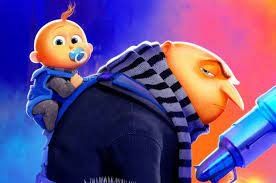
The arrival of Gru Jr. gives the movie a new source of comedy. A baby in an animated franchise can be a risky choice, because it can easily become one repeated joke. Here, the idea works best when the baby becomes a tiny disruption to Gru’s confidence. Gru is used to being feared, respected, or at least obeyed by his Minions. His own baby is not impressed by any of that.
I found that dynamic amusing because it makes Gru vulnerable in a fresh way. He cannot negotiate with Gru Jr. through speeches, gadgets, or old villain charisma. The baby reacts on instinct, and Gru has to deal with the emotional comedy of not being adored automatically. That gives the film a cute but also fitting angle: even after all his growth, Gru still has to learn new kinds of patience.
Maxime Le Mal Has Big Cartoon Villain Energy
Maxime Le Mal fits the Despicable Me world because he feels theatrical from the first moment. He is not a quiet threat. He is flashy, petty, stylish, and proud of his own ridiculousness. I liked that the film leans into his exaggerated personality rather than trying to make him too serious. This franchise works best when villains feel like they have designed their entire identity around a costume, a grudge, and a very specific personal brand.
His rivalry with Gru adds a schoolyard flavor to the conflict, which I found funny. It is not only about danger; it is about ego, old resentment, and the absurd drama of people who never truly left their past behind. Maxime’s presence also gives the movie a chance to return to the franchise’s love of strange villain culture. The gadgets, costumes, lairs, and overconfident speeches all feel like part of the same comic tradition.
The Minions Turn Chaos Into Their Own Language
The Minions are still the franchise’s wildest ingredient. They do not need a complex arc to take over a scene. Their appeal comes from rhythm, sound, movement, and the feeling that they are always half a second away from causing a new disaster. In Despicable Me 4, their scenes are as loud and strange as expected, but I still found myself laughing at the physical timing.
What makes the Minions work for me is that they operate by their own logic. They are loyal, but not reliable. Helpful, but only by accident. Brave, but often because they do not fully understand what is happening. The movie uses them as bursts of cartoon energy whenever the main story needs acceleration. Some moments are pure silliness, but that has always been their role. They are not there to be subtle. They are there to turn order into confetti.
The Animation Is Glossy, Fast, and Built for Motion
Visually, Despicable Me 4 has the polished look I expect from Illumination. The characters have rubbery movement, expressive faces, and designs that favor strong silhouettes. Gru’s narrow frame, Lucy’s bright energy, the girls’ softer shapes, and the Minions’ simple yellow forms all remain instantly readable. That clarity helps the comedy land quickly.
The film’s aesthetics are strongest when it plays with contrast. Gru’s dark wardrobe against cheerful suburban spaces is funny before he even speaks. The villain designs are colorful and theatrical. The action scenes move with speed and elasticity, giving the movie a playful texture rather than a realistic one. I also liked the bright, clean visual style, which keeps the film accessible for younger viewers while still offering enough detail to make the world feel busy and lively.
Comedy Comes From Family Pressure and Pure Absurdity
The humor in Despicable Me 4 is built from two main sources: family stress and cartoon nonsense. I preferred the scenes where those two overlap. Gru trying to handle domestic life with the seriousness of a secret mission is funnier than any single gag on its own. The franchise has always been good at placing emotional sincerity beside ridiculous behavior, and this film continues that approach.
Not every joke lands with the same force, and the movie sometimes moves so quickly that a funny idea is gone before it can fully develop. Still, the overall comic rhythm kept me engaged. There is a cheerful confidence to the silliness. The film does not pretend to be delicate. It wants fast reactions, expressive faces, strange voices, and sudden visual surprises. When I accepted that pace, the comedy became easier to enjoy.
The Story Is Crowded but Never Empty
Despicable Me 4 has a lot happening at once. There is a new villain, a family relocation, Gru Jr., the girls’ adjustments, Lucy’s challenges, Minion chaos, and several action-driven sequences. At times, I felt the film juggling more pieces than it could explore deeply. Some ideas could have used more room, especially the family’s attempt to live under new identities.
Even so, the movie rarely feels empty. Its strength is not tight plotting as much as momentum and character familiarity. I already know this family, so even quick scenes carry built-in affection. The film relies on that connection, and for the most part, it works. I did not need every subplot to be profound. I wanted the movie to feel energetic, funny, colorful, and emotionally recognizable, and it usually does.
The Family Theme Still Gives the Franchise Its Shape
Under the gadgets, villains, disguises, and Minion mayhem, Despicable Me 4 is still about family. That is the reason Gru remains appealing after multiple films. He began as someone who wanted control and status, but the series keeps placing him in situations where love makes control impossible. This film continues that pattern by giving him new forms of responsibility he cannot master through old habits.
I liked that the movie does not treat family as calm or perfect. Family here is noisy, inconvenient, embarrassing, and constantly changing. Gru has to protect his loved ones, but he also has to understand them. He has to accept that being a father is not a role he can complete once and then store away like a finished invention. It keeps asking more from him, and that ongoing challenge gives the film its emotional pulse.
Why the Fourth Chapter Still Has Spark
What kept me invested in Despicable Me 4 was the combination of familiar affection and fresh disruption. The movie knows its audience already understands Gru, Lucy, the girls, and the Minions, so it does not waste time rebuilding the entire foundation. Instead, it throws them into another round of identity trouble, family chaos, and villain spectacle.
I found the result bright, fast, and pleasantly uneven in the way many animated comedies are. Some scenes exist mainly for laughs, others for action, and others to remind me that Gru’s odd little family is still the heart of everything. The film’s charm comes from that mixture. It is glossy and loud, but it also remembers that a former villain trying to be a good dad is still one of the funniest and warmest ideas this franchise has ever had.