
A Small Blue Dog With a Huge Emotional Range
I came to Bluey expecting a sweet children’s series, something light, bright, and easy to keep in the background. What I found instead was one of the most observant family shows I have seen in years. It looks simple at first: a young blue heeler puppy plays with her sister, parents, friends, neighbors, and classmates. But the longer I watched, the more I noticed how carefully the series understands childhood, parenting, imagination, and the tiny emotional storms that shape an ordinary day.
Bluey works because it does not talk down to children, and it does not flatter adults with fake wisdom either. It treats play as serious business. A game in the living room can become a lesson in patience. A silly argument can reveal fear. A trip to the park can carry more emotional truth than a much larger adventure. I like that the show trusts small moments. It does not need loud spectacle to feel important. It finds meaning in make-believe, chores, bedtime, car rides, visits, and those strange family rituals that seem trivial until you realize they are how love becomes visible.
The Visual Style Feels Soft, Clear, and Instantly Friendly
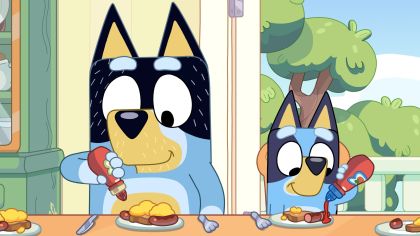
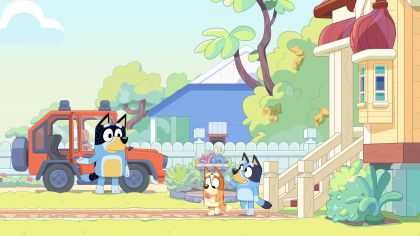
The aesthetics of Bluey are one of the first reasons I felt comfortable inside its world. The design is clean and colorful without feeling artificial. The characters have simple shapes, expressive faces, and warm colors that make every scene easy to read. Nothing feels overloaded. The backgrounds are gentle but detailed enough to make the world feel lived in: kitchens, yards, schools, parks, beaches, and bedrooms all have their own quiet personality.
I especially like how the show uses space. The Heeler family home feels familiar after only a few episodes, almost like a place I have visited. The rooms are open enough for play, but specific enough to carry memory. A couch is not just furniture; it can become a mountain, a boat, a shop, or a battlefield of pillows. The yard can shift from ordinary grass to a kingdom, a jungle, or a stage for some highly specific childhood rule that only makes sense for the next seven minutes. That flexibility is central to the show’s charm.
Bluey Is Curious, Bossy, Kind, and Very Real
Bluey herself is not written as a perfect child, and that is exactly why I like her. She can be imaginative, generous, energetic, impatient, controlling, confused, and deeply loving, sometimes all in the same episode. She often wants the game to go her way, and the show does not hide that. Instead, it lets her learn through play, through frustration, through watching others react to her choices.
What makes Bluey such a strong main character is her emotional openness. She feels everything fully. A small disappointment can become enormous. A new idea can take over her entire world. A family moment can become a treasured ritual before she even knows why it matters. I see her as a character who captures the speed of childhood feeling. Children do not always separate imagination from emotion neatly, and Bluey reflects that beautifully.
Bingo Brings the Quiet Magic
Bingo might be my favorite part of the series because she often carries a softer kind of wonder. She is younger, gentler, and more inward than Bluey, but she is not simply the cute little sister. Her episodes often reveal how rich a quieter child’s inner world can be. She notices things others miss. She feels deeply, but sometimes she needs time to understand what she feels.
I appreciate that the show gives Bingo emotional complexity without making her overly dramatic. Her stories often involve small acts of courage: speaking up, joining a game, being patient, handling disappointment, or making sense of change. She reminds me that childhood is not only loud discovery. Sometimes it is private processing. Sometimes it is standing in a hallway, holding a small feeling that adults might not notice unless they slow down.
Bandit and Chilli Make Parenting Look Playful but Not Effortless
Bandit and Chilli are a major reason Bluey resonates with adults. They are loving, funny, tired, occasionally distracted, and often wonderfully committed to their children’s games. I like that they are not presented as perfect parents. They make mistakes. They get worn out. They sometimes want a moment of peace. Yet they also show how much emotional work can happen inside play.
Bandit often joins games with impressive dedication, turning ordinary parenting into improvisational theater. Chilli brings warmth, steadiness, and emotional clarity, though she also has moments where her own needs matter. Together, they make the family dynamic feel balanced and believable. The show understands that good parenting is not about always having the right answer. It is often about being present enough to listen, flexible enough to join the game, and honest enough to repair a moment when it goes wrong.
Play Is the Show’s Real Language
Bluey treats play as more than entertainment. In this series, play is how children test the world. It is how they practice fairness, power, fear, empathy, patience, and independence. A pretend shop can become a lesson in responsibility. A game of keepy-uppy can become a family memory. A role-playing scenario can help a child understand a social rule better than a lecture ever could.
I like that the show rarely explains this too heavily. It lets the game unfold, and the meaning appears naturally. That gives the episodes a lovely rhythm. At first, I might think I am watching a silly activity, but by the end, I realize the game has revealed something true about one of the characters. The writing is clever because it respects how children learn. They do not always absorb wisdom through direct instruction. They often learn by pretending, repeating, testing, and laughing.
The Humor Feels Honest, Not Manufactured
The comedy in Bluey comes from recognition. I laughed because the family arguments, strange child logic, parental exhaustion, and unpredictable games all felt familiar. The humor is gentle but sharp. It notices how children can create rules with total confidence, then change those rules the moment the game no longer favors them. It notices how parents sometimes agree to a game before realizing they have signed up for something physically inconvenient and emotionally elaborate.
What I enjoy most is that the jokes do not feel forced. The show does not rely on constant punchlines. It lets humor grow from behavior. Bandit committing too deeply to a bit, Bluey overexplaining a game, Bingo quietly misunderstanding something, or Chilli trying to keep order while still honoring the children’s imagination can all be funny because they feel rooted in character.
The Music Gives Ordinary Moments a Glow
The music in Bluey is one of its secret strengths. It often turns simple scenes into something graceful and memorable. A walk, a game, a quiet realization, or a family interaction can feel almost poetic because of the way the score supports it. The music does not overpower the story; it lifts it.
I noticed that the show often uses music to suggest emotion before the characters can name it. That is especially effective in episodes built around growing up, waiting, sharing, or accepting that something cannot stay exactly the same. The melodies make the world feel warm, but they can also carry a light ache. That emotional texture is part of why Bluey stays with me after an episode ends, even when the episode itself was only a few minutes long.
The Pacing Respects Short Attention Spans Without Feeling Shallow
Each episode of Bluey is short, but the storytelling rarely feels thin. The show knows how to set up a situation quickly, develop a game, reveal a feeling, and leave space for reflection. I admire that economy. There is very little wasted time. Every gesture, line, and visual detail tends to serve the emotional shape of the episode.
The pacing also makes the show easy to revisit. Some episodes feel like tiny comedies. Others feel like small family dramas. Others are almost meditative. Because the episodes are compact, the series can explore a wide range of moods without becoming heavy. I can watch one episode for comfort, another for laughter, and another because I want to feel quietly moved by something simple and honest.
Why Bluey Feels Different From Ordinary Family Animation
What makes Bluey stand apart for me is its respect for both sides of family life. It understands children as imaginative, emotional, and complicated. It understands parents as loving people who are also tired, flawed, and still learning. It understands that a family is not built only through big speeches or major events. It is built through repeated little acts: joining a game, listening to a worry, making room for silliness, apologizing, trying again.
The show’s power comes from how lightly it carries these ideas. It does not need to announce that it is meaningful. It simply shows a family moving through ordinary days with humor and tenderness. I find that refreshing. Bluey can be playful without being empty, emotional without being manipulative, and educational without feeling like a lesson sheet. It feels like a show made by people who remember childhood clearly and understand parenting from the inside.
The Episodes Leave Space for My Own Memories
One of the reasons Bluey connects with me is that it leaves room for personal memory. The specific games may belong to Bluey and Bingo, but the emotions feel widely recognizable. Wanting attention, fearing change, inventing rules, misunderstanding adults, craving control, learning fairness, and discovering that parents have feelings too are experiences that travel beyond the show’s Australian setting.
I also like that the series does not flatten childhood into constant sweetness. It allows boredom, jealousy, stubbornness, sadness, confusion, and overexcitement to exist beside joy. That makes the warmth feel earned. Bluey is comforting not because nothing difficult happens, but because the difficult moments are held inside a loving world. The result is a series that feels bright on the surface and quietly wise underneath, with enough humor, beauty, and emotional detail to make a simple family cartoon feel unexpectedly rich.