
30 Jul
Sophia Bennett
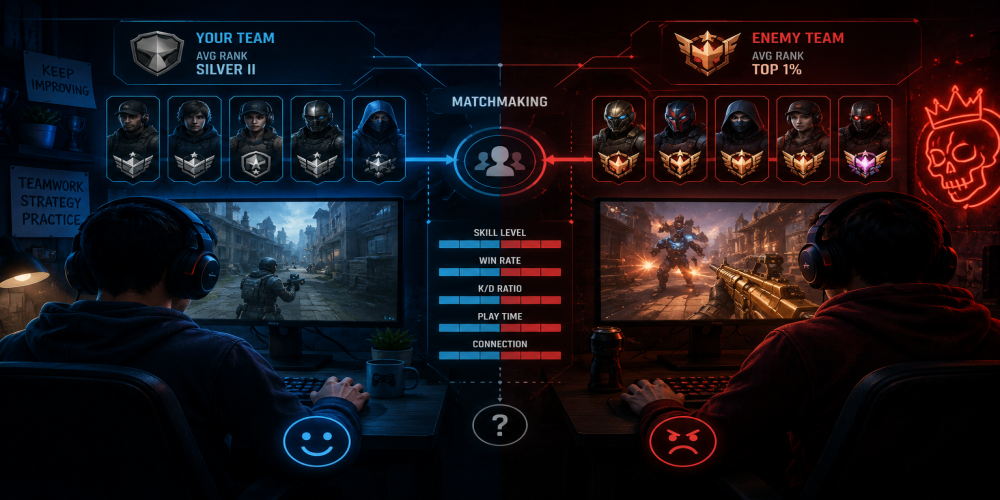
Online matchmaking has an apparently simple purpose: find several players, divide them into teams, and start a game. From the player’s perspective, the system may look like little more than a queue and a loading screen. Behind that short wait, however, the game is trying to solve several difficult problems at the same time.
It must find people with similar ability, acceptable internet connections, compatible platforms, appropriate party sizes, suitable roles, and reasonable queue times. It may also consider region, input method, account history, rank, recent performance, preferred mode, and whether the player is returning after a long break.
These goals frequently conflict. A perfectly balanced match might require a long wait. The nearest players may have very different skill levels. Two teams with similar average ratings may still have completely different strengths. A coordinated group of friends can outperform several individually talented strangers, even when the rating system considers both teams equal.
This is why matchmaking can feel unfair even when the system is working as intended. It is not choosing from every player in the world. It is choosing from the people who are available, compatible, and searching for the same activity at that exact moment.
What Matchmaking Is Trying to Accomplish
Most matchmaking systems attempt to produce games that are competitive, responsive, and quick to start. These goals sound compatible, but improving one can weaken another.
Competitive Balance
The system tries to place players against opponents with similar ability. In a team game, it may attempt to make the total strength of both sides approximately equal.
Connection Quality
Players should connect to an appropriate server with manageable latency and limited packet loss. A balanced match can still feel terrible when actions register late.
Reasonable Queue Time
Most players do not want to wait fifteen minutes for every game. The system usually expands its acceptable search range as the queue becomes longer.
Compatible Team Structure
A five-player group may be matched against another organized group rather than five solo players. Role-based games may also need a specific number of tanks, healers, defenders, attackers, or other positions.
Stable Player Experience
The system may protect new players, identify returning accounts, detect unusually strong early performance, or separate suspicious accounts from the general population.
A matchmaking algorithm is therefore not answering one question. It is negotiating between several priorities under a time limit.
What Is MMR?
MMR stands for matchmaking rating. It is an internal estimate of a player’s current ability. The exact formula varies between games, and publishers often keep the details private to reduce manipulation.
A basic system may increase rating after a victory and reduce it after a defeat. More advanced systems can consider the expected result, opponent strength, uncertainty, team composition, and individual performance.
MMR is usually represented internally as a number, even when the player sees ranks such as Bronze, Silver, Gold, Diamond, or Master.
A Rating Is an Estimate, Not a Perfect Measurement
Skill is difficult to reduce to one number. A player may have excellent mechanical accuracy but poor map awareness. Another may communicate well and support teammates without producing impressive personal statistics.
The rating system does not understand a player in the way a human coach might. It observes measurable results and uses them to predict future outcomes.
Visible Rank and Hidden Rating Are Not Always the Same
Many competitive games display a public rank while maintaining a separate hidden MMR.
The visible rank provides understandable progression. The hidden rating is used to create matches and may respond more quickly to changes in performance.
This separation explains why two players with the same visible rank can enter very different lobbies. One may have a hidden rating near the upper edge of the division, while the other has recently fallen from a higher level or returned after a long absence.
Why Games Use Two Systems
- Visible ranks provide clear seasonal goals;
- Hidden ratings can adjust without dramatic visual changes;
- Rank protection can prevent one poor session from feeling disastrous;
- Placement systems can move strong players through lower divisions faster;
- Seasonal resets can change the displayed rank without erasing all skill information.
How Rating Systems Predict Match Results
Matchmaking does not usually search for players with exactly identical ratings. It estimates the probability that one player or team will defeat another.
When both sides have similar ratings, the predicted result may be close to fifty percent. When one side is stronger, the expected result shifts.
Ratings may change based on that expectation. Defeating a stronger opponent can provide more progress than defeating a weaker one. Losing to a much stronger team may produce a smaller penalty.
This prediction is never certain. A team with a sixty percent estimated chance of winning will still lose many matches. Matchmaking works with probability, not guarantees.
Why a 50% Expected Win Rate Does Not Mean Every Match Is Close
A common misunderstanding is that fair matchmaking should make every round competitive until the final moment.
Two equally rated teams can still produce a one-sided game. Early mistakes may create an economic or positional advantage. One team may have better communication, stronger character combinations, or greater familiarity with the selected map.
Individual performance also changes from match to match. A normally reliable player may be tired, distracted, testing a new role, or experiencing connection problems. Another may be performing unusually well.
The system can balance expected ability. It cannot control how every person performs during the next twenty minutes.
Why Average Team Rating Can Be Misleading
Imagine two teams with the same average MMR.
Team A contains five players with similar ratings. Team B contains two highly rated players and three much less experienced teammates. The mathematical average may be identical, but the match can feel completely different.
In some games, the strongest players can control the pace and compensate for weaker teammates. In others, one vulnerable position can decide the entire match.
Team averages also ignore relationships between roles. A highly rated support player may not compensate for a struggling frontline player in the same way another strong frontline player would.
Team Balance Happens After Players Enter the Lobby
Finding ten suitable players is only the first part of the process. The game must then decide how to divide them.
A team-balancing system may consider:
- Total rating on each side;
- Highest-rated player;
- Lowest-rated player;
- Role preferences;
- Party relationships;
- Input method;
- Recent performance;
- Platform;
- Character or class experience.
Balancing every variable perfectly may be impossible. Improving one category can make another less equal.
Why Parties Are Difficult to Balance
A group of friends has advantages that individual ratings may not fully capture. They may communicate through voice chat, understand each other’s habits, coordinate strategies, and select complementary roles.
Five solo players with the same average rating may be individually strong but lack the same organization.
Games attempt to compensate by matching organized groups against other groups or adjusting the expected strength of a party. This becomes difficult when the queue contains only one large group.
The system then faces an unpleasant choice: keep the group waiting, create a match with uneven party sizes, or expand the skill range.
Mixed-Skill Parties Create Another Problem
A highly experienced player may queue with a new friend. Matching near the stronger player’s rating can overwhelm the beginner. Matching near the beginner’s level can produce an unfair advantage for the experienced player.
Using the average rating appears reasonable but may still create an uncomfortable match for everyone involved.
Why Solo Players Sometimes Face Organized Teams
Ideally, organized parties compete against similarly organized opponents. Player population does not always make that possible.
This can happen when:
- Few players are searching in the region;
- The mode has a small population;
- The party has been waiting for a long time;
- The game prioritizes connection quality;
- The queue accepts mixed party structures;
- Cross-platform settings reduce the available pool.
The match may be numerically balanced while remaining strategically uneven.
Connection Quality Can Matter More Than Rating
A competitive match is not useful when the connection makes it difficult to play. Matchmaking often begins by searching within a nearby region or data center.
Latency measures the time required for information to travel between the player and the server. Higher latency can delay movement, aiming, ability activation, and damage confirmation.
Packet loss creates missing or incomplete information. Jitter causes latency to change unpredictably. Both can make the game feel inconsistent even when the average ping appears acceptable.
Why Connection-Based Matching Can Create Skill Gaps
In a region with a small player population, the system may have to choose between distant opponents with similar skill and nearby opponents with different ratings.
Many games initially prioritize connection and gradually widen the skill range. This creates smoother technical performance but may produce less competitive teams.
Why Queue Times Change Match Quality
Matchmaking usually begins with strict requirements. It searches for players close to the current rating, region, and preferred conditions.
If no suitable match appears, the search window expands.
After enough time, the system may accept:
- A larger rating difference;
- A different server region;
- Unequal party sizes;
- Broader role combinations;
- Cross-platform opponents;
- Players with different input devices.
This prevents endless waiting, but the final match may feel less balanced than one created during peak hours.
Why Playing at Off-Peak Hours Feels Different
Matchmaking quality depends heavily on the number of available players. A popular mode during the evening has more possible combinations than a quiet mode early in the morning.
At off-peak times, players may notice:
- Wider rank ranges;
- Repeated opponents;
- Longer queue times;
- More distant servers;
- Mixed party sizes;
- Greater variation in player experience.
The algorithm may be unchanged. The available population is different.
Popular Modes Usually Have Better Matchmaking
A large player pool gives the system more options. It can find similar ratings without sacrificing connection quality or queue speed.
Smaller modes are more difficult to balance, especially when they require unusual team sizes or specific roles.
This creates a feedback loop. Poor matches push players away from the mode, reducing its population and making future matches even harder to balance.
Role-Based Matchmaking Adds Complexity
Games with defined roles cannot simply gather players with similar ratings. They need the correct team structure.
A queue may contain many players selecting damage-focused roles and very few choosing support or defensive positions. The system can find enough total players but still lack the roles required to start.
To reduce waiting, games may offer:
- Role incentives;
- Priority passes;
- Flexible role queues;
- Separate ratings for each role;
- Automatic role assignment;
- Expanded matchmaking ranges for rare roles.
Each solution creates trade-offs. A player using an unfamiliar role may have an inaccurate rating. A reward may encourage people to select a role they do not genuinely want to play.
Why Separate Role Ratings Can Be More Accurate
A player may perform at an advanced level in one role and an average level in another. One universal rating cannot represent both accurately.
Separate role ratings allow the game to place the player according to the selected position. This reduces the chance that an experienced attacker enters a high-level support lobby without comparable support experience.
The limitation is data. A rating becomes reliable only after enough matches. Rarely used roles may remain uncertain for a long time.
Uncertainty Is a Hidden Part of Matchmaking
Modern rating systems often track not only estimated skill but also confidence in that estimate.
A player with hundreds of recent matches may have a stable rating. A new account, returning player, or person switching platforms has much greater uncertainty.
When uncertainty is high, the system may change the rating rapidly. A few strong performances can move the player into harder lobbies. Several poor games may move them down quickly.
This is why early ranked matches can feel inconsistent. The system is still learning where the player belongs.
Placement Matches Are Data Collection
Placement games are not always a separate tournament deciding one final rank. They are often a period during which the system gathers information with increased uncertainty.
It may consider:
- Previous-season rating;
- Unranked matchmaking history;
- Performance during placement games;
- Opponent strength;
- Account age;
- Role selection;
- Party composition.
Winning every placement game does not guarantee the highest rank because the system may begin with an existing estimate.
Why New Accounts Can Disrupt Matches
A new account provides little information. The system may initially place it near an average skill level and adjust after observing performance.
If the player is genuinely new, early matches may be too difficult. If the player is highly experienced on another account, early opponents may be much weaker.
Games try to identify unusual performance quickly through accuracy, movement, decision speed, win rate, and other signals. Moving an account too quickly can also misclassify a talented beginner or a player having several fortunate games.
What Is Smurfing?
Smurfing occurs when an experienced player uses a new or lower-rated account to enter easier matches.
Reasons may include playing with lower-ranked friends, avoiding difficult queues, testing unfamiliar roles, creating content, or seeking easier opponents.
Smurfing makes matches feel unfair because the visible account history does not reflect the player’s real experience.
How Games Respond
- Rapid rating adjustment;
- Account-level requirements for ranked modes;
- Phone verification;
- Performance-based detection;
- Separate suspicious-account pools;
- Limits on party rank differences;
- Faster movement through early divisions.
No solution is perfect. Strong new players and returning veterans can resemble smurfs without intentionally manipulating the system.
Why Individual Performance Is Difficult to Measure
It seems reasonable to reward the best player on a losing team, but identifying that player is complicated.
High damage does not always mean useful damage. A support player may prevent losses without producing visible highlights. A defender may create space while receiving poor personal statistics. A player collecting easy eliminations may contribute less than someone completing the objective.
Performance-based rating can also change behavior. Players may focus on statistics that protect their rating instead of making decisions that help the team.
Possible Unintended Behaviors
- Avoiding risky objective play;
- Prioritizing personal score;
- Selecting characters with favorable statistics;
- Extending lost matches to farm numbers;
- Ignoring team needs;
- Protecting survival statistics rather than attempting a comeback.
For this reason, many ranked systems place greater weight on the final result than on individual statistics.
Why Winning and Losing Streaks Happen
Players often suspect that matchmaking deliberately creates streaks. In many cases, streaks can emerge naturally from probability, changing performance, and rating adjustment.
After several victories, a player may enter stronger lobbies. Fatigue may also increase during a long session. A player who becomes frustrated may communicate less effectively or make riskier decisions.
Losses can then cluster together.
Streaks may also be influenced by:
- Playing at a different time of day;
- Switching roles;
- Joining a mixed-skill party;
- Testing new equipment;
- Map rotation;
- Temporary connection problems;
- Small sample size.
Does Matchmaking Force a 50% Win Rate?
Skill-based systems often move players toward opponents who produce an expected win rate near fifty percent. This is not necessarily the same as forcing a specific sequence of wins and losses.
When a player improves, they win more frequently for a period. Their rating rises, and they begin facing stronger opponents. The win rate then moves closer to balance.
A stable fifty percent rate can indicate that the system has found an appropriate level. It does not prove that individual games are predetermined.
The important distinction is between creating evenly matched opponents and secretly choosing who must win. Matchmaking generally attempts the first.
Why Strong Players Still Lose in Lower-Rated Lobbies
One strong individual cannot control every variable in a team game. They may receive an unfamiliar map, an unsuitable team composition, or opponents who coordinate better.
The game may also expect the strong player to compensate for weaker teammates. If team averages are balanced, the opposing side may contain several moderately strong players rather than one standout participant.
This can create the feeling that the system is asking one person to carry the entire team.
What Players Call Engagement-Optimized Matchmaking
Players sometimes use the term engagement-optimized matchmaking to describe systems designed around continued play rather than pure skill balance.
In theory, such a system might consider how different match outcomes affect the likelihood that a person continues playing. It could attempt to reduce long losing streaks, provide easier matches after frustration, or shape lobby experiences around retention.
It is important to separate documented systems from community speculation. Without reliable information from the developer, players cannot always determine whether a match was shaped by engagement goals or ordinary rating factors.
A frustrating match alone does not prove intentional manipulation.
Why Matchmaking Algorithms Are Often Secret
Developers rarely publish every matchmaking rule. Full transparency could help players understand the system, but it may also make manipulation easier.
Players might attempt to:
- Lower their rating intentionally;
- Exploit party calculations;
- Avoid certain queue conditions;
- Optimize statistics unrelated to team success;
- Identify protected matchmaking pools;
- Manipulate placement uncertainty.
Secrecy protects the system but also creates distrust when matches feel inconsistent.
Cross-Platform Matchmaking Creates New Trade-Offs
Cross-platform play increases the available player population, improving queue times and regional coverage. It can also combine players using different hardware and input methods.
Potential differences include:
- Controller versus mouse input;
- Frame rate;
- Display refresh rate;
- Field-of-view settings;
- Loading speed;
- Communication tools;
- Platform-specific assistance features.
Games may separate input pools, allow players to disable cross-play, or use aim assistance to reduce the gap.
Input-Based Matchmaking Is Not Always Simple
Separating controller and mouse users appears straightforward until parties contain both. The system may place the entire group into the broader input pool.
Players can also switch devices, use accessibility hardware, or play through cloud services. Input advantage varies by game genre and specific mechanics.
Mouse input may support rapid precision, while controller movement and assistance systems may perform well in close-range encounters. There is no universal advantage across every game.
Why Bots Sometimes Appear in Matchmaking
Games may use computer-controlled players to reduce queue times, introduce beginners gradually, or fill missing positions.
Bots are common in early matches because new players need time to learn controls and maps without immediately facing experienced opponents.
They may also appear when:
- The regional population is low;
- A mode requires many participants;
- A player leaves before the match begins;
- The game wants rapid onboarding;
- A casual mode prioritizes fast starts.
Problems arise when the game does not clearly communicate that bots are present.
Why Casual Modes Can Feel More Difficult Than Ranked
Ranked matchmaking usually has a strong reason to maintain skill accuracy. Casual modes may prioritize queue speed, flexible parties, or connection quality.
A casual lobby can therefore contain:
- New players;
- Top-ranked competitors warming up;
- Mixed-skill friend groups;
- Players testing unfamiliar roles;
- Returning accounts;
- People using different input methods.
The visible lack of rank restrictions can create greater skill variation than a competitive queue.
Why Ranked Modes Can Feel More Consistent
Ranked play often has stricter party limits, narrower rating ranges, role rules, and stronger penalties for leaving.
Players may also take objectives more seriously and select familiar characters. This creates a more predictable environment even when the average mechanical skill is higher.
Consistency does not always mean easier. It means the match follows clearer expectations.
Map Knowledge Can Create Hidden Skill Differences
Two players with similar overall ratings may have very different experience on a particular map.
One may understand every route, objective timing, defensive angle, and environmental interaction. The other may be mechanically strong but unfamiliar with the layout.
Matchmaking rarely has enough data to create perfect map-specific ratings, especially when maps rotate frequently.
Character Selection Can Make Equal Teams Look Unequal
Team composition can transform a balanced lobby into a one-sided match. Players may choose characters that perform poorly together or fail to answer the opponent’s strategy.
The algorithm cannot always predict final selections, substitutions, or tactical choices.
Even when it knows character preferences, forcing ideal compositions would reduce player freedom.
Patch Changes Temporarily Reduce Rating Accuracy
A major update can change character strength, weapon behavior, maps, movement, or objectives. Players who excelled under the previous rules may need time to adapt.
Their rating still reflects earlier performance, so matches can feel unstable until enough new data is collected.
New characters and mechanics also create knowledge gaps. A player may understand the game broadly but struggle against an unfamiliar ability.
Seasonal Resets Can Create Uneven Early Matches
Competitive games often reset or compress visible ranks at the beginning of a season. This creates renewed progression and encourages players to return.
If ratings are moved closer together, early matches can contain people who finished the previous season at very different levels.
Some systems preserve hidden MMR to reduce this effect. Others allow greater early-season movement, producing more variation until the ladder stabilizes.
Why Rank Compression Exists
Without resets or compression, inactive players might remain at outdated ranks, and seasonal progression would feel less meaningful.
Compression can:
- Encourage new placement activity;
- Remove rating inflation;
- Adjust for major gameplay changes;
- Give returning players a fresh path;
- Rebuild the competitive distribution.
The cost is temporary instability.
Leavers Create Matches the Algorithm Cannot Repair
A match may begin balanced and become unfair when someone disconnects, stops participating, or leaves intentionally.
Replacement systems are difficult in ranked play because a new participant enters an ongoing game without equal context or preparation.
Games may respond with:
- Temporary reconnection windows;
- Reduced rating penalties for teammates;
- Stronger penalties for repeated leaving;
- Match cancellation during the opening period;
- Bot replacements;
- Surrender options.
Each solution can be exploited. Players might pressure teammates to leave or intentionally disconnect from difficult matches.
Why Rating Protection Is Limited
Completely protecting teammates whenever someone leaves sounds fair, but it creates opportunities for manipulation.
A group could assign one person to disconnect whenever defeat appears likely. Players might also harass a teammate in the hope that they leave and protect everyone else’s rating.
Most systems therefore combine limited protection with penalties and detection rather than removing every consequence.
Matchmaking Cannot Measure Motivation
Two equally rated players may enter a match with different goals.
One wants to climb the ranking ladder. Another wants to finish a daily challenge. A third is testing a new character. Someone else may be playing while distracted.
The algorithm can estimate ability but cannot perfectly measure effort during the upcoming match.
This is a major reason online games feel inconsistent. The same person can perform at different levels depending on motivation and context.
Why Recent Performance May Matter
Some systems adjust more strongly to recent matches, while others rely on a larger historical record.
Using recent performance helps detect improvement or decline quickly. Relying too heavily on it can make ratings unstable.
A player may have several unusually strong games and be placed into difficult lobbies before their long-term skill has changed. Another may experience a poor evening and fall below an appropriate level.
Good systems balance responsiveness with stability.
How Matchmaking Handles Returning Players
A player returning after a year may still have a high historical rating but lack current knowledge and practice.
Games can address this by increasing uncertainty, using temporary placement games, reducing the old rating, or observing unranked performance first.
Reducing too much places experienced players against beginners. Reducing too little creates a difficult return experience.
Why Match Quality Is Hard to Measure
Developers can measure score difference, match duration, surrender rate, disconnects, player reports, and whether people continue playing afterward.
None of these perfectly captures fairness.
A close score may hide a frustrating experience. A short match may be enjoyable if one team executes an excellent strategy. A long match can feel exhausting rather than competitive.
Player surveys and behavioral data can help, but subjective experience remains difficult to convert into one metric.
Fair Does Not Always Feel Fun
A perfectly matched opponent demands concentration. Every mistake is punished, and victory requires consistent effort.
Some players describe this as tiring because there are few relaxed matches. They may prefer occasional games against weaker opponents, even though those matches are less fair for the other side.
This creates a design challenge. Competitive balance and casual variety do not always produce the same emotional experience.
Why Easy Matches Feel Natural but Hard Matches Feel Manipulated
People often attribute success to their own ability and failure to external factors. A strong victory may feel deserved, while a difficult defeat makes matchmaking seem suspicious.
Memory also favors emotional extremes. Players remember the teammate who struggled dramatically or the opponent who controlled the entire lobby. Ordinary balanced matches attract less attention.
This does not mean complaints are always wrong. It explains why personal experience can feel more uneven than long-term statistics suggest.
Small Sample Sizes Create Misleading Impressions
Five matches are not enough to judge an entire matchmaking system. Random variation can produce several difficult games in a row.
A larger sample provides a clearer picture. Players can track:
- Win rate;
- Score difference;
- Average queue time;
- Rank range;
- Party size;
- Connection quality;
- Time of day;
- Selected role.
Patterns may reveal that matches become less balanced in a specific mode, region, or time window.
Why Rank Symbols Can Distort Expectations
Players may assume that everyone within the same visible rank has identical ability. Divisions usually represent ranges rather than exact points.
A player at the bottom of Gold and another near promotion to Platinum can have meaningfully different ratings while sharing the same broad badge.
Seasonal resets, hidden MMR, inactive accounts, and party adjustments can widen the apparent difference further.
How Matchmaking Tries to Prevent Exploitation
Competitive systems monitor unusual patterns such as intentional losses, account sharing, suspicious party behavior, and rapid changes in performance.
Possible responses include:
- Rating adjustments;
- Temporary restrictions;
- Separate review pools;
- Account verification;
- Match cancellation;
- Reward removal;
- Competitive bans.
Detection systems can make mistakes, so reliable appeal and review processes remain important.
Why Matchmaking Cannot Fix Poor Game Balance
Even ideal player matching cannot compensate for severe balance problems inside the game.
If one character, strategy, weapon, or starting position has a major advantage, equally skilled teams may still produce predictable results.
Players often blame matchmaking when the deeper issue involves:
- Map imbalance;
- Overpowered character combinations;
- Unclear objectives;
- Weak comeback systems;
- Excessive early advantages;
- Poor role design.
Comeback Mechanics Affect Perceived Fairness
Some games include systems that help a trailing team recover. Others allow early advantages to grow steadily.
Strong comeback mechanics keep matches competitive but can make the leading team feel that successful early play was not rewarded. Weak comeback mechanics create more one-sided results.
Matchmaking chooses the players. The game’s internal economy determines how quickly a small difference becomes a large one.
What Developers Can Do to Improve Trust
Full algorithm disclosure is not always practical, but clearer communication can reduce confusion.
Useful Transparency Includes
- Explaining whether matchmaking uses hidden MMR;
- Showing party-size differences;
- Displaying connection region;
- Clarifying seasonal resets;
- Explaining how rank progression differs from matchmaking;
- Publishing broad matchmaking goals;
- Acknowledging population-related limitations;
- Providing match-history tools.
Players are more likely to accept imperfect results when they understand the trade-offs.
Should Games Display Every Player’s Rating?
Showing exact ratings can make matchmaking easier to evaluate. It can also encourage blame before the match begins.
Players may decide that a teammate is weak based on one number, ignore uncertainty, or give up after seeing a highly rated opponent.
Hidden information reduces pre-match hostility but increases suspicion after a poor result.
What Players Can Do to Improve Match Quality
Play During Active Hours
Larger player populations give the system more suitable options.
Choose Popular Modes
Less populated activities usually require wider matchmaking ranges.
Use the Nearest Server Region
Stable latency improves the practical quality of otherwise balanced matches.
Avoid Very Wide Party Skill Gaps
Mixed-skill groups are difficult to place comfortably.
Learn More Than One Role
Flexibility can reduce queue time and improve team composition.
Take Breaks After Frustrating Streaks
Fatigue and frustration change decision-making even when rating remains unchanged.
Review Matches, Not Only Results
A defeat does not automatically mean the lobby was unfair. Examine positioning, communication, objectives, and team choices.
How to Tell Whether a Match Was Truly Uneven
No single sign proves a matchmaking failure, but several indicators together can suggest a significant imbalance.
- Large visible rank differences;
- An organized team against solo players;
- Several new accounts performing at an advanced level;
- Extreme connection differences;
- Missing required roles;
- Repeated matches against the same dominant group;
- Very short matches across a large sample;
- One team consistently controlling every objective.
One unusual game may be random. A repeated pattern deserves closer attention.
Why Scoreboards Do Not Tell the Full Story
Scoreboards emphasize measurable actions. They may not capture communication, positioning, distraction, objective timing, resource management, or defensive pressure.
A teammate near the bottom may have made several decisions that allowed others to succeed. A player at the top may have collected impressive numbers without supporting the main objective.
Using the scoreboard as the only proof of matchmaking quality oversimplifies team performance.
Why Personal Improvement Can Make Matchmaking Feel Worse
As players improve, the system places them against stronger opponents. Techniques that once produced easy victories become ordinary requirements.
This can create the impression that progress is not being rewarded. In reality, the challenge increases because the rating recognizes improvement.
The player may be performing much better than several months earlier while maintaining a similar win rate.
The Difference Between Rank Progress and Skill Progress
Rank is a relative position within a competitive population. Skill is personal ability.
A player can improve while remaining in the same division if the broader community also improves. Seasonal changes, new strategies, and educational content raise the general standard over time.
Improvement can be measured through:
- Better decisions;
- More consistent mechanics;
- Improved communication;
- Fewer repeated mistakes;
- Greater role flexibility;
- Stronger performance against advanced opponents.
Why Matchmaking Feels Different Across Genres
A duel game can compare two individual ratings directly. A large team game must account for many relationships.
Battle royale games face another challenge because dozens of players enter one match and only one person or team wins. Racing games must consider vehicle performance and track familiarity. Card games may include deck strength and collection size.
| Genre | Main Matchmaking Challenge |
|---|---|
| One-on-one fighting game | Skill and connection accuracy |
| Team shooter | Roles, parties, and communication |
| Battle royale | Large lobby size and low individual win rate |
| Strategy game | Map knowledge and faction matchups |
| Card game | Player ability and deck strength |
| Racing game | Driver skill, vehicle class, and track experience |
Collection Strength Can Affect Matchmaking
In games with unlockable cards, characters, or equipment, account power may influence results alongside player skill.
A skilled player with a limited collection may struggle against an equally skilled opponent with optimized options.
Some games consider equipment level, team power, or deck strength. Others rely only on rating and assume progression differences will eventually appear in results.
Matching by account power can also be exploited when players intentionally equip weaker items before entering the queue.
Why Beginners Need Protected Matchmaking
New players require time to learn controls, maps, objectives, and game language. Placing them immediately against veterans creates a poor introduction.
Beginner pools may use account level, tutorial completion, early performance, or a separate introductory rating.
Protection cannot last forever. Experienced players creating new accounts also make beginner identification difficult.
What Makes Matchmaking Feel Fair?
Players are more likely to perceive fairness when:
- Queue times are predictable;
- Connection quality is stable;
- Visible ranks are reasonably close;
- Party structures are similar;
- Both teams have suitable roles;
- Matches remain competitive for a meaningful period;
- Rating changes are understandable;
- Leavers are handled consistently;
- Strong performance produces visible progress over time.
Perceived fairness depends on clarity as much as mathematics.
What Makes Matchmaking Feel Unfair?
- Hidden rules with no explanation;
- Large skill variation;
- Coordinated groups against solo players;
- Poor connection quality;
- Frequent new accounts with advanced performance;
- Unclear rank changes;
- Repeated one-sided matches;
- Wide role or equipment differences;
- Long queues followed by poor lobbies;
- No visible response to reports or leaving.
A Practical Checklist After a Difficult Match
- Check whether the opponents were an organized party;
- Review connection quality;
- Consider the time and regional population;
- Examine role and character combinations;
- Identify whether an early advantage grew rapidly;
- Separate individual mistakes from rating differences;
- Look for new or returning accounts;
- Compare several matches rather than one;
- Take a break before continuing while frustrated.
Why Perfect Matchmaking Is Impossible
Perfect matchmaking would require complete knowledge of each player’s current ability, role preference, connection, mood, map experience, character choice, communication quality, and performance in the next match.
It would also need a huge population searching for the same mode at the same time and willing to wait as long as necessary.
Real systems work with incomplete information and limited options. They estimate, compromise, and update after observing results.
The system can produce an excellent match and still receive an unpredictable outcome. It can also produce a mathematically imperfect lobby that becomes memorable and competitive.
How to Think About Matchmaking More Realistically
Matchmaking is not a promise that every game will be enjoyable or equal. It is a process that attempts to improve the probability of a suitable match.
A useful evaluation focuses on long-term patterns:
- Do opponents become stronger as you improve?
- Are most connections stable?
- Do visible rank differences remain reasonable?
- Are organized groups handled consistently?
- Does the system adjust new and returning players?
- Do repeated results move your rating appropriately?
An occasional poor game is unavoidable. Persistent, measurable imbalance suggests a deeper problem.
Why Online Games Sometimes Feel Unfair
Online matches feel unfair because visible results are shaped by more than skill rating. Connection, parties, roles, maps, character selection, player motivation, account uncertainty, queue population, and random variation all influence the experience.
A rating system can estimate long-term ability, but it cannot know whether a player is tired, experimenting, distracted, or about to have their best game of the week.
The fairest matchmaking systems make thoughtful compromises. They prioritize stable connections, use ratings that adapt over time, account for organized groups, protect beginners, and communicate how ranks work.
Players can improve their own experience by choosing active modes, playing during populated hours, avoiding extreme party skill gaps, maintaining a stable connection, and judging patterns across many games rather than reacting to one painful defeat.
Matchmaking is most successful when neither team notices it. The game starts quickly, the connection feels responsive, both sides have opportunities, and the outcome depends on decisions made inside the match.
When one of those conditions fails, the algorithm becomes visible—and players begin wondering whether the system was ever fair at all.