14 Jul
Olivia Hayes
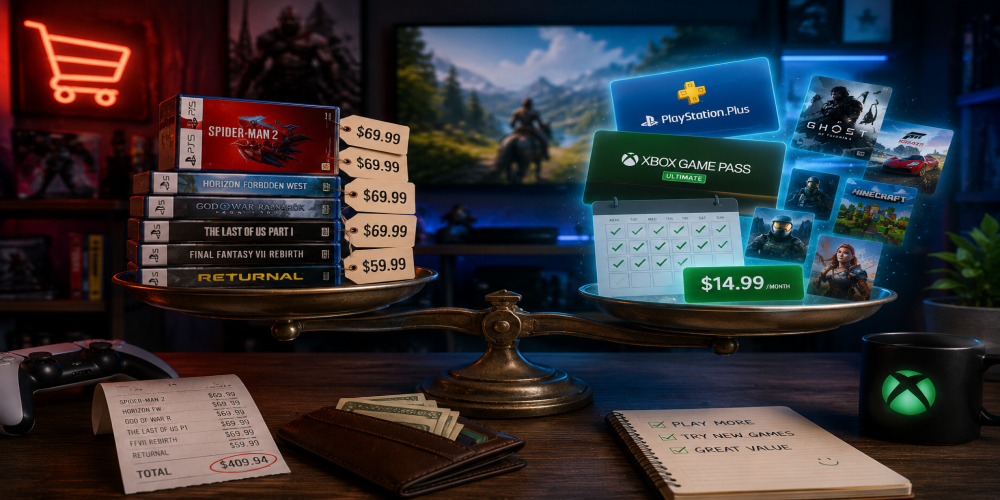
Game subscriptions are often promoted as the cheapest way to play. For one monthly payment, players receive access to a large catalog that may include blockbuster releases, independent games, online multiplayer, cloud streaming, classic titles, and occasional discounts.
Compared with paying full price for every new game, the value can look almost impossible to beat. A subscription may cost less than two major releases per year while offering hundreds of downloadable titles. Play three or four good games, and the service appears to have paid for itself.
The calculation becomes less convincing when actual playing habits enter the picture. Many subscribers download games they never start, rush through titles before they leave the catalog, continue paying during months when they barely play, and eventually purchase favorite games anyway. A service that looks inexpensive on a monthly screen can become a substantial recurring expense over several years.
Whether a game subscription is cheaper depends on more than the number of games included. The important questions are how often you play, which games you choose, whether you replay them, how patient you are with discounts, and how much you value permanent access.
The Basic Subscription Comparison
The simplest comparison looks at annual subscription cost against the price of games purchased separately.
Imagine a gaming subscription costs the equivalent of $15 per month. Over one year, the player spends $180. At a typical full launch price of $70, buying three major games would cost $210.
Under that comparison, the subscription wins after the player completes roughly three full-price games included in the catalog.
The real calculation is rarely that clean. Players do not always buy games at launch, subscriptions do not include every desired release, and access disappears after cancellation.
Simple Break-Even Formula
A useful estimate is:
Annual subscription cost divided by the average price you would actually pay for each game.
For example:
- Annual subscription: $180;
- Average purchased-game price: $45;
- Break-even point: four games.
The subscription becomes financially efficient only if the player completes or meaningfully enjoys at least four games they would otherwise have purchased for around $45 each.
Full Price Is Often the Wrong Comparison
Subscription advertising frequently compares the service with the total retail value of every game in the catalog. This produces an impressive number, but it does not reflect normal purchasing behavior.
Most players would never buy hundreds of games individually. They also frequently purchase titles during sales, borrow physical copies, buy pre-owned discs, wait for permanent price reductions, or skip games that receive poor reviews.
If a $70 release is usually purchased six months later for $35, the subscription must replace two discounted purchases to create the same saving as one launch-day purchase.
Compare Against Your Real Habits
Ask what you would genuinely have paid without the service:
- Would you buy the game at launch?
- Would you wait for a discount?
- Would you buy it pre-owned?
- Would you borrow it?
- Would you skip it completely?
- Would you buy it only after playing it through a subscription?
A game you would never have purchased should not be counted as a full-price saving. It may add entertainment value, but it did not replace an expense.
Access Is Not the Same as Ownership
Buying a game normally provides continued access through the purchased account or physical disc, subject to platform and server limitations. A subscription provides access only while several conditions remain true.
- The subscription must remain active;
- The game must stay in the catalog;
- The platform must continue supporting it;
- The account must remain in good standing;
- Online-dependent features must still operate.
When the subscription ends, access usually ends as well. Save data may remain, but the game cannot be continued unless the player subscribes again or purchases a copy.
This means the subscription fee is better compared with renting a changing library than building a permanent collection.
Catalog Rotation Changes the Value
Subscription catalogs are not fixed. Games enter and leave according to licensing agreements, publisher strategies, and platform decisions.
Rotation provides variety, but it introduces uncertainty. A player may begin a long RPG and discover that it leaves the service before completion. Another game may disappear before the player has time to start it.
Rotation Creates Hidden Costs
- Players may purchase a game to finish it;
- Long games can feel rushed;
- Download time may be wasted;
- DLC purchased for the subscription version may become unusable;
- Planned games may leave before the player reaches them;
- A favorite game may require an unexpected purchase.
Some services announce departures in advance, but the notice period may still be too short for a 70-hour adventure.
The Backlog Illusion
A catalog containing hundreds of titles creates the impression of endless value. The problem is that time, not game availability, is usually the true limitation.
A player with five hours of gaming time per week has roughly 260 hours per year. That may be enough for four large games, ten medium-length games, or a larger number of short experiences.
The remaining catalog has no direct financial value if there is no time to use it.
Subscriptions can even make choosing harder. Instead of starting one purchased game, players browse dozens of options, download several, play each for an hour, and return to the menu. The service contains more entertainment, but the player receives less satisfaction.
Cost Per Game Can Be Misleading
Some subscribers divide the annual fee by the number of games they launched. If they opened 30 titles during a $180 subscription, the cost appears to be only $6 per game.
Opening a game is not the same as receiving meaningful value from it. A more useful calculation considers games completed or played for a substantial period.
Better Measures of Subscription Value
- Cost per completed game;
- Cost per hour of enjoyable play;
- Number of purchases genuinely avoided;
- Number of games discovered and enjoyed;
- Cost of additional games purchased outside the service;
- Value of included multiplayer or cloud features.
Even cost per hour has limitations. A repetitive 100-hour game is not automatically better value than a memorable eight-hour adventure.
Subscriptions Are Strongest for Variety Players
The ideal subscription user enjoys trying many genres and does not need to keep every game permanently.
This player may finish a story game, test an experimental independent title, play a cooperative release with friends, and move to something new within the same month.
A Subscription Is More Likely to Save Money When You:
- Complete several games per year;
- Enjoy exploring unfamiliar genres;
- Rarely replay completed games;
- Would otherwise buy new releases near launch;
- Use included multiplayer benefits;
- Share the service through supported household features;
- Cancel during quieter periods;
- Frequently play titles added on release day.
The ability to try games without an additional purchase is one of the model’s strongest benefits. A disappointing game costs time, but not another $70.
Subscriptions Are Weaker for Focused Players
Some players spend most of the year with one or two games. They may enjoy a competitive shooter, sports title, MMO, strategy game, or large open-world release for hundreds of hours.
For them, a broad catalog provides little advantage. Buying the few games they actually use may cost less than maintaining a subscription indefinitely.
Buying Is More Likely to Be Cheaper When You:
- Play only a few games each year;
- Replay favorites regularly;
- Wait for major discounts;
- Buy and resell physical games;
- Prefer specific franchises absent from the catalog;
- Take long breaks from gaming;
- Want permanent offline access;
- Keep games for many years.
The Cost of Paying During Inactive Months
Recurring billing is one of the main reasons subscriptions become more expensive than expected.
A player may actively use the service during a major release month, then barely touch it for the next three months. The payments continue because cancellation requires a deliberate action.
At $15 per month, three inactive months cost $45. Over several years, passive subscription periods can erase much of the apparent saving.
Signs You Are Paying for Inactivity
- You cannot remember the last included game you completed;
- You mainly play a separately purchased title;
- You keep the subscription because you might use it later;
- You claim monthly games without playing them;
- You browse the catalog more than you play;
- You are subscribed to several overlapping services.
Turning off automatic renewal immediately after subscribing can prevent accidental long-term payments. Access normally continues until the paid period ends.
Annual Plans Are Cheaper but Less Flexible
Annual subscriptions often reduce the monthly equivalent price. The saving can be substantial for players who use the service continuously.
The disadvantage is commitment. Paying for a year removes the option to cancel during months with no interesting additions.
An annual plan is most sensible when the service also provides a feature needed throughout the year, such as console multiplayer, cloud saves, family access, or a consistently used game catalog.
It is less attractive when the player subscribes mainly for one new release.
Day-One Releases Can Change the Calculation
A major game included on its release day can make one month of subscription access look extremely valuable.
Instead of purchasing the game for $70, the player may subscribe for one month, complete it, and cancel. Financially, that can be an excellent deal.
Several details complicate the strategy:
- The game may be too long to finish in one month;
- DLC may not be included;
- The player may eventually want permanent access;
- Save compatibility may vary between editions;
- The subscription price may rise;
- The release may arrive only on a premium tier.
Short, story-focused games create the clearest one-month value. Long multiplayer or sandbox games may justify ownership instead.
The “Subscribe, Finish, Cancel” Strategy
Players can reduce costs by treating subscriptions as temporary access rather than permanent utilities.
- Wait until several desired games are available;
- Subscribe for one or two months;
- Prioritize those games;
- Turn off automatic renewal;
- Finish the planned list;
- Cancel until the catalog becomes attractive again.
This approach offers more value than maintaining several subscriptions continuously. It does require planning and the willingness to delay games until enough titles accumulate.
Multiple Subscriptions Can Become More Expensive Than Buying
One service may feel affordable. Problems begin when players maintain subscriptions across console, PC, cloud gaming, publisher catalogs, MMOs, and mobile passes.
For example, four services averaging $12 per month create an annual cost of $576. That amount could purchase several new games and many discounted releases while leaving permanent access to most of them.
Subscription Stacking Often Includes:
- A console multiplayer plan;
- A premium game catalog;
- A PC library service;
- A publisher-specific membership;
- A cloud gaming platform;
- An MMO subscription;
- Seasonal passes inside individual games.
Each fee may look small in isolation. The total annual cost tells a different story.
Online Multiplayer Changes the Comparison
On some consoles, a subscription is required for online multiplayer in many paid games. That makes the service partially unavoidable for players who regularly play online.
If the basic membership already provides multiplayer, cloud storage, and monthly games, the additional cost of upgrading to a larger catalog may be smaller than the full subscription price.
The correct comparison is therefore not always subscription versus no subscription. It may be:
Basic multiplayer membership plus purchased games versus premium membership with a catalog.
Players who never use online multiplayer should not assign value to a feature they do not need.
Monthly Games and Claimed Libraries
Some services allow members to claim a small selection each month and access those games while their subscription remains active.
Over several years, this can create a large library. Its value depends on how many claimed titles the player actually uses.
There is also a psychological effect: canceling feels like losing access to a collection accumulated over time. This can keep players subscribed even when they no longer use the current service.
The claimed library may feel owned, but access remains tied to active membership.
Subscription Discounts Can Save Money
Members may receive discounts on games, expansions, cosmetics, or add-ons. These discounts can offset part of the membership cost.
However, a discount only saves money when the purchase was already planned. Buying an unnecessary game because it is 20% cheaper still increases total spending.
Calculate the Real Saving
If a subscription costs $120 per year and membership discounts save $30, the remaining effective cost is still $90.
Do not compare the discount with full retail price if the game regularly receives the same reduction during public sales.
DLC Is Often Not Included
Subscription catalogs frequently provide the base game while selling expansions, season passes, characters, and premium editions separately.
This can create an awkward situation. The player purchases DLC for a game they do not own. If the base game leaves the catalog or the subscription ends, the add-on becomes unusable until the base game is purchased.
Before Buying DLC for a Subscription Game, Check:
- Whether the base game is likely to leave soon;
- Whether a complete edition is discounted;
- Whether save data transfers to a purchased copy;
- Whether the DLC works across platforms;
- Whether the subscription includes a different edition;
- Whether buying the full package is cheaper.
Physical Games Can Recover Part of Their Cost
A physical game can often be resold, traded, lent, or shared after completion. The true cost is therefore the purchase price minus the amount recovered later.
A player might buy a new physical game for $70 and sell it for $45. The effective cost of playing it was $25.
A subscription payment cannot normally be recovered. Once the month passes, the fee is spent regardless of how much the service was used.
Physical Ownership Advantages
- Possible resale value;
- Ability to lend the game;
- Access without an active subscription;
- Potential collector value;
- Freedom to buy used copies;
- Permanent possession of the disc.
A physical disc may still require updates or online services, so it does not guarantee permanent preservation in every case.
Digital Sales Can Beat Subscription Pricing
Patient players can build large permanent libraries through seasonal sales, bundles, giveaways, and price reductions.
A game that launches at $70 may later cost $20 or less. Independent games often appear in inexpensive bundles. Older titles may be given away temporarily.
If a player purchases only deeply discounted games, the break-even point for a subscription becomes much higher.
An annual service costing $180 would need to replace nine purchases averaging $20 each to create a direct saving.
Bundles Complicate the Comparison
Game bundles can provide several permanent titles for the cost of one subscription month. The player may not want every included game, but the same problem exists in subscription catalogs.
Bundles are strongest for:
- Older games;
- Independent titles;
- Complete franchise collections;
- PC players comfortable using multiple stores;
- Players building a long-term library.
Subscriptions are stronger when the desired games are new and expensive.
Renting Can Be Better Than Owning Some Games
Not every game needs permanent ownership. A linear adventure may provide everything valuable in one playthrough. After the credits, the player may have no intention of returning.
Subscription access works well for these titles because it lowers the cost of temporary entertainment.
Ownership is more useful for games with:
- High replay value;
- Long-term multiplayer;
- Extensive mod support;
- Creative building systems;
- Multiple story routes;
- Frequent personal use;
- Strong sentimental importance.
The Value of Trying Before Buying
Subscriptions can function as large demo libraries. Players can test a game without relying only on trailers, reviews, or refund windows.
This can prevent expensive mistakes. A player may discover that a critically praised RPG does not suit their taste after one hour. Without the service, that experiment might have cost full price.
The subscription may also lead to additional purchases when a game becomes a favorite. This is not necessarily a failure of the service. It provided a low-risk way to discover something valuable.
Discovery Has Real Value
Financial comparisons often ignore discovery. A subscription encourages players to try genres and developers they would never risk buying.
A short experimental game, unusual puzzle title, or small narrative adventure can be easier to start when no separate purchase is required.
This value is difficult to calculate, but it matters. A subscription may not reduce spending if the player later buys more games, yet it may improve the quality and variety of their gaming experience.
Subscriptions Can Encourage Wasteful Consumption
Easy access can reduce commitment. When hundreds of games are available, abandoning one after ten minutes has no visible financial cost.
This freedom is useful when a game is genuinely unenjoyable. It can also prevent players from giving unfamiliar mechanics enough time to become interesting.
The result may be constant sampling without deeper engagement.
Common Subscription Behaviors
- Downloading more games than storage allows;
- Starting several games in one evening;
- Abandoning slow introductions quickly;
- Choosing shorter games only because they may leave;
- Feeling pressure to maximize the monthly fee;
- Playing what is available instead of what is truly desired.
The Pressure to “Get Your Money’s Worth”
Subscriptions can create an obligation to use them. A player may choose an included game over a purchased favorite because the subscription fee feels wasted otherwise.
This changes gaming from leisure into cost recovery.
A service is not saving money when it pushes the player to spend limited free time on titles they do not particularly want to play.
Time has value even when it does not appear on a receipt.
How Long Games Affect Subscription Value
A 100-hour RPG may provide excellent value through one month of access if the player can finish it quickly. For someone with limited weekly time, it may require several months.
At $15 per month, a four-month playthrough costs $60 in subscription fees. If the game is available permanently for $30 during a sale, buying is cheaper.
Long games favor ownership when:
- The player progresses slowly;
- The game may leave the catalog;
- Replay value is high;
- DLC is planned;
- The player enjoys taking long breaks;
- Other catalog titles remain unused during the playthrough.
Short Games Often Favor Subscription Access
Shorter narrative and independent games can create strong subscription value because several can be completed in one billing period.
A player may finish four ten-hour games in a month. Buying each separately, even at moderate prices, could cost much more than temporary access.
This assumes the player actually has enough free time and interest to complete them.
Family and Household Sharing
Supported family sharing can significantly improve subscription value. One membership may serve several people with different tastes.
A family might use:
- Children’s games;
- Sports titles;
- Cooperative adventures;
- Educational releases;
- Single-player blockbusters;
- Cloud streaming across devices.
The cost per user decreases when several household members use the service regularly.
Sharing rules vary. Some services limit simultaneous play, require a home console, or restrict cloud features to the primary account.
Cloud Gaming Adds a Different Type of Value
Cloud streaming may allow games to run on devices that could not normally support them. This can reduce the need for expensive hardware, downloads, or storage upgrades.
The value depends on connection quality and service availability.
Cloud Benefits
- No large installation;
- Play across several devices;
- Test games quickly;
- Reduced local storage needs;
- Access without a high-end gaming PC.
Cloud Limitations
- Input delay;
- Image compression;
- Dependence on internet quality;
- Data usage;
- Limited regional availability;
- No access after cancellation or removal.
Subscription Price Increases Matter
A service that was excellent value at launch may become less attractive after repeated price increases or tier changes.
Players should reevaluate rather than assuming a subscription remains worthwhile because it once was.
Check:
- Current annual cost;
- Features moved to higher tiers;
- Frequency of useful additions;
- Number of games you completed recently;
- Alternative sale prices;
- How often the service was inactive.
The Catalog’s Size Matters Less Than Its Relevance
A service with 800 games is not automatically better than one with 100. The useful catalog is the portion the player genuinely wants to play.
A practical evaluation is to create a list of available titles you would realistically start within the next six months.
If only two games qualify, the enormous total catalog should not influence the calculation.
First-Party Catalogs Can Offer Stable Value
Games owned by the subscription platform are more likely to remain available than temporary third-party additions, although permanent inclusion is never guaranteed.
A strong first-party catalog can make a service valuable for new console owners who missed an earlier generation of releases.
Longtime users may receive less value because they already own or have completed many of the major titles.
New Players and Existing Players See Different Value
A new player entering an established platform may gain access to years of acclaimed releases for one fee. The subscription provides an inexpensive way to catch up.
An experienced player may already own the best-known games. New monthly additions then need to carry most of the value.
This explains why the same subscription can feel generous to one person and disappointing to another.
The Opportunity Cost of Waiting
Some players delay purchases because a game might enter a subscription later. This can save money, but it may also mean waiting years or missing the period when friends and communities are most active.
The decision involves both price and timing.
Buying at launch may be worthwhile when:
- Friends are playing immediately;
- The multiplayer population matters;
- Spoilers are difficult to avoid;
- The game is a personal priority;
- A physical copy can be resold;
- The developer deserves direct support in the player’s view.
Subscriptions Change How Games Are Valued
When every title appears under one monthly fee, players may think less about the individual price of each game. This can help smaller games reach larger audiences.
It can also make players undervalue development work. A 12-hour adventure may be dismissed as insufficient because it was completed quickly, even though the same experience might have felt worthwhile as a carefully chosen purchase.
Subscription value should not be measured only by how many hours can be extracted.
Do Developers Earn Less From Subscriptions?
The financial arrangement varies. Developers may receive an upfront licensing payment, compensation based on engagement, funding for development, or another negotiated structure.
Subscriptions can provide exposure and guaranteed revenue, especially for smaller studios. They may also reduce direct sales or change how success is measured.
For players, the important point is that using a subscription is not identical to purchasing a copy directly. Those two actions may support a developer differently.
The Risk of Game Removal
A subscription user may lose access to a game while an owner keeps it. This matters most when the player has:
- An unfinished campaign;
- Purchased DLC;
- A long-term multiplayer group;
- Extensive save data;
- Plans for a replay;
- Emotional attachment to the title.
Some services offer a temporary member discount before removal. Buying during that period may preserve access, but it also adds a new expense to the subscription cost.
Ownership Is Also Not Perfectly Permanent
Buying digitally does not guarantee access forever. Stores can close, accounts can be restricted, licenses can change, and online-only games can shut down.
Physical games can also depend on patches, servers, or downloadable content.
The difference is degree of control. Ownership usually provides a stronger claim to continued access than a rotating subscription, but modern games often retain some external dependencies.
A Five-Year Cost Comparison
Long-term totals reveal the real scale of recurring payments.
A $15 monthly subscription costs:
- $180 after one year;
- $540 after three years;
- $900 after five years.
At an average purchase price of $30, $900 could buy 30 games permanently.
The subscription may still be better value if the player completes far more games, uses multiplayer services, shares the account, or relies on cloud gaming. The important point is that a small monthly fee becomes a large long-term commitment.
Buying Five Games Per Year
Consider a player who buys five games each year at an average discounted price of $35.
The annual cost is $175, nearly identical to a $15 monthly subscription.
Buying leaves the player with five permanent games. The subscription provides a much larger temporary catalog.
The better choice depends on whether the player values focused ownership or broad variety.
Buying Two Games Per Year
A player buying two $70 games spends $140 per year. If those games are not included in the desired subscription, maintaining the service creates an additional cost rather than a saving.
For this player, buying is probably cheaper unless online multiplayer or another membership benefit is essential.
Playing Ten Included Games Per Year
A player who completes ten included games that would otherwise cost an average of $40 receives about $400 of personally relevant access from a $180 service.
This is a strong subscription use case, provided those purchases genuinely would have happened without the membership.
The Best Method: Track Actual Use
Instead of guessing, keep a simple record for several months.
Record:
- Monthly subscription cost;
- Games started;
- Games completed;
- Games you would have purchased;
- Realistic sale price for each game;
- Additional DLC purchases;
- Months with little or no use;
- Other included services used.
After six or twelve months, compare the fee with avoided purchases and meaningful play.
A Practical Value Table
| Player Type | Likely Better Option |
|---|---|
| Plays many different games | Subscription |
| Buys two or three games yearly | Buying |
| Waits for deep sales | Buying |
| Wants launch-day included releases | Subscription |
| Replays favorites often | Buying |
| Uses required console multiplayer | Subscription may offer better combined value |
| Likes short experimental games | Subscription |
| Collects physical editions | Buying |
| Plays one long game at a time | Buying or temporary subscription |
| Shares with a household | Subscription |
How to Make a Game Subscription Cheaper
Turn Off Automatic Renewal
Do this immediately after subscribing. The current paid period normally remains active.
Subscribe Only When Needed
Wait until several wanted games are available.
Use Annual Plans Carefully
Buy a year only when you know the service will be used consistently.
Avoid Overlapping Catalogs
Rotate between services rather than keeping all of them active.
Finish Shorter Priority Games First
Complete titles likely to leave before beginning permanent first-party games.
Check Removal Notices
Do not begin a long game without knowing whether it is scheduled to depart.
Use Supported Family Sharing
Divide value across several active users when platform rules allow it.
Do Not Buy Unnecessary DLC
Consider purchasing a complete edition instead.
How to Make Buying Games Cheaper
Wait for Sales
Prices often decline substantially within a year.
Buy Physical Copies
Used games and resale can reduce the effective cost.
Use Wish Lists
Price notifications reduce impulse purchases.
Buy Complete Editions
These may cost less than purchasing the base game and DLC separately.
Avoid Backlog Purchases
A discounted game is not a saving when it remains unplayed indefinitely.
Borrow and Share Legally
Physical lending can reduce costs within families and friend groups.
The Hybrid Strategy Is Often the Cheapest
The choice does not need to be permanent. Many players benefit from combining temporary subscriptions with selective ownership.
A Balanced Strategy
- Buy favorite long-term games;
- Subscribe for short releases and experimentation;
- Cancel after completing priority titles;
- Purchase subscription discoveries only during deep discounts;
- Use physical copies for games with resale value;
- Keep only one catalog subscription active at a time.
This preserves access to important games without paying continuously for catalogs that are not being used.
Questions to Ask Before Subscribing
- Which included games will I genuinely play this month?
- Would I otherwise purchase them?
- What would I realistically pay during a sale?
- How many hours do I have available?
- Is the game likely to leave soon?
- Will I buy DLC?
- Do I need the multiplayer benefits?
- Can I cancel after one month?
- Am I already paying for another similar service?
- Do I want access or ownership?
Warning Signs a Subscription Is Not Saving Money
- You mainly play games purchased separately;
- You have not completed an included title in several months;
- You subscribe because canceling feels like losing a library;
- You maintain multiple similar services;
- You buy most interesting games anyway;
- You purchase DLC for rotating catalog titles;
- You forget about recurring payments;
- You spend more time browsing than playing;
- You feel pressure to use the service;
- Your backlog continues growing despite access to hundreds of games.
Signs the Subscription Is Providing Strong Value
- You regularly complete included games;
- You avoid several planned purchases each year;
- You enjoy trying unfamiliar titles;
- You use multiplayer, cloud saves, or streaming;
- Several household members benefit;
- You cancel during inactive periods;
- You rarely purchase included games afterward;
- You value access more than collecting;
- The service includes releases you would buy at launch;
- Your annual use clearly exceeds the fee.
The Psychological Cost of an Endless Library
Subscription value is not purely financial. A large catalog can create decision fatigue and a sense that every session should be optimized.
Players may feel guilty for replaying a favorite because hundreds of untouched games are available. They may rush through stories to move to the next title or abandon games because another option is one download away.
Buying one carefully selected game can create a calmer experience. The player has already made the decision and can focus on enjoying it.
Convenience Also Has Value
A subscription reduces research and purchasing friction. Parents can offer children a changing library without approving every individual purchase. Friends can choose cooperative games that everyone already has access to. Players can test titles without navigating refund rules.
This convenience may justify part of the fee even when the direct financial saving is modest.
Why There Is No Universal Winner
Two players can use the same service and receive completely different value.
One completes 15 included games, uses online multiplayer every week, and shares the library with family. Another plays one purchased multiplayer title and occasionally claims monthly games.
The first player may save hundreds. The second may be paying a recurring fee for benefits they barely use.
The Most Honest Calculation
Do not count every game in the catalog. Count only games you played and would otherwise have purchased.
Do not compare only with launch prices. Use the price you normally pay.
Do not ignore inactive months, DLC, additional purchases, or overlapping services.
Do not treat claimed games as permanently owned.
Also include genuine benefits such as discovery, multiplayer access, household use, convenience, and cloud streaming.
Are Game Subscriptions Actually Cheaper?
They can be. For active players who complete several included games each year, enjoy variety, and use the additional features, a subscription can provide excellent value.
They are not automatically cheaper. Players who buy a few discounted games, replay favorites, prefer physical ownership, or leave subscriptions active during long breaks may spend more over time.
The monthly price is designed to feel smaller than buying a new game. The annual and multi-year totals reveal the real commitment.
The strongest approach is usually intentional rather than loyal. Subscribe when the catalog contains enough games you genuinely want. Cancel when it does not. Buy titles that deserve a permanent place in your library, and avoid paying several services for the possibility that you may use them later.
A subscription saves money only when it replaces purchases or provides features you actively use. When it becomes another automatic bill attached to an untouched catalog, buying games would often have been cheaper.