Plastic Pink Becomes Surprisingly Personal
I expected Barbie to be bright, witty, and visually polished, but I did not expect it to feel so emotionally restless under all that shine. The film begins in a world that looks like a toy aisle brought to life, yet it quickly becomes something sharper: a story about identity, performance, impossible expectations, and the strange pressure of being seen as a symbol before being seen as a person.
What I liked most is that Barbie never treats its artificiality as a weakness. The houses have no real walls, the cars move with playful unreality, and the sky seems designed by someone who believes clouds should behave like accessories. Instead of hiding the doll-like nature of the world, the movie turns it into its main visual language. Everything looks too perfect, and that perfection becomes part of the tension. I found myself laughing at the exaggeration while also noticing how carefully it reflects the roles people are pushed to perform.
Barbie Land Looks Like a Dream With Rules
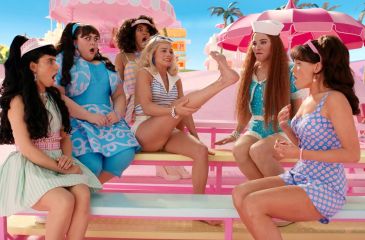
The aesthetics are the film’s most immediate pleasure. Barbie Land is not just pink; it is aggressively, confidently, almost philosophically pink. The color palette feels like a statement before anyone speaks. Every house, outfit, pool, road, and prop seems arranged to create a world where happiness has been turned into architecture.
I enjoyed the handmade quality of the design. The sets do not chase realism, and that makes them more charming. Water is not really water. Food is not really food. Movement often feels choreographed like play. This gives the film a theatrical rhythm, as though I am watching children’s imagination expanded to blockbuster scale. At the same time, the perfection is slightly eerie. Barbie Land looks free, but everyone inside it seems to follow an invisible script. That contrast gives the movie much of its personality.
Margot Robbie Makes Perfection Feel Fragile
Margot Robbie’s Barbie works because she does not play the character as a joke. She gives Barbie brightness, sincerity, confusion, and a very specific kind of innocence. At first, her Barbie seems complete because her world tells her she is complete. She wakes up beautiful, admired, and surrounded by celebration. But the moment doubt enters her life, the entire fantasy begins to wobble.
I found her performance strongest in the quiet moments when Barbie starts noticing discomfort without fully understanding it. Robbie makes that confusion feel real. Her smile does not disappear all at once; it flickers. Her confidence does not collapse instantly; it becomes uncertain. That gradual change gives the character emotional weight. She is not simply learning that the real world is complicated. She is learning that being an idea is not the same as being alive.
Ken Turns Insecurity Into Spectacle
Ryan Gosling’s Ken brings a different kind of energy. He is funny, needy, theatrical, and oddly touching because his entire identity is attached to being noticed by Barbie. His comedy comes from exaggeration, but underneath it there is a recognizable sadness. Ken does not really know who he is without someone else’s attention.
I liked how the film uses Ken to explore insecurity rather than making him only a comic side figure. His journey is absurd, but it has a clear emotional shape. He mistakes validation for purpose. He treats confidence like a costume. He tries to build an identity out of poses, slogans, outfits, and borrowed attitudes. Gosling makes this both hilarious and uncomfortable, because Ken’s silliness is rooted in a very human need to matter.
The Real World Feels Messier by Design
When Barbie leaves Barbie Land, the film changes texture. The real world is less symmetrical, less flattering, and far less welcoming. I liked that this shift is not shown as a simple escape from fantasy into truth. The real world has its own artificial roles, its own performances, and its own rules. It is not automatically wiser just because it is less pink.
This contrast gives the movie a sharper edge. Barbie discovers that being admired as an object is not the same as being respected as a person. She also learns that the symbol she represents has different meanings for different people. Some see joy, nostalgia, and imagination. Others see pressure, exclusion, and impossible standards. I appreciated that the film lets those contradictions exist together instead of trying to smooth them into one easy message.
Comedy With a Pointed Smile
The humor in Barbie is fast, strange, and often very self-aware. I enjoyed how the movie jokes about its own brand history while still using that history seriously. It knows the audience arrives with opinions about Barbie before the first scene begins. Rather than avoiding that baggage, the film opens the box and plays with every piece inside.
The comedy works best when it comes from contrast: perfect dolls discussing existential fear, glamorous characters discovering ordinary discomfort, or toy-world logic colliding with adult anxiety. Some jokes are broad, but many have a precise satirical bite. The film laughs at gender roles, corporate language, beauty standards, and the way society packages identity into neat categories. I never felt that the humor was only decoration. It keeps pushing the story forward by revealing how ridiculous certain expectations become when taken literally.
A Story About Identity Hidden Inside a Toy Box
At its center, Barbie is not really about a doll becoming human in a simple fairy-tale way. It is about the frightening freedom of not having a fixed script. Barbie begins as a finished product. She has a look, a function, a place, and a name everyone recognizes. The crisis begins when she realizes that a perfect role can also be a cage.
I found this theme more effective than I expected. The film asks what happens when someone stops being satisfied with being an image. Barbie’s journey is not only about entering the real world. It is about discovering uncertainty, discomfort, and choice. That makes the story feel more personal than its glossy surface suggests. The movie understands that identity is not always found in confidence. Sometimes it begins with confusion.
The Supporting Characters Add Texture
The supporting cast gives the film its crowded, playful rhythm. The different Barbies make Barbie Land feel like a universe built from variations on aspiration. Each one reflects a promise: success, beauty, intelligence, leadership, style, achievement. Their presence is funny because everyone is both unique and part of a repeated design.
America Ferrera’s character adds an important human perspective. She gives the movie emotional grounding, especially when the story turns toward the contradictions women are expected to carry. Her presence helps connect Barbie’s symbolic crisis to ordinary life. The film needs that bridge. Without it, Barbie Land might remain a clever visual concept. With it, the story gains a more direct emotional charge.
Music, Movement, and the Joy of Excess
The musical energy of Barbie is one of its strongest tools. The film often moves like a pop fantasy, using rhythm, choreography, and performance to make emotions larger than life. I liked how the songs and dance sequences do not feel separate from the story. They express the world’s artificial brightness, Ken’s dramatic insecurity, and Barbie Land’s habit of turning feeling into display.
The movement also adds to the toy-like quality. Characters pose, glide, dance, and arrange themselves as though invisible hands have placed them into scenes. This could have felt stiff, but the film turns it into style. The result is playful and theatrical. It reminded me that Barbie has always existed somewhere between object, character, fashion icon, and fantasy. The movie uses that in-between status with real confidence.
The Film’s Smartest Trick Is Its Contradiction
What makes Barbie interesting to me is that it is both a brand movie and a critique of brand thinking. It celebrates the doll’s cultural power while questioning the expectations attached to her. It uses a famous commercial image to talk about identity, aging, beauty, ambition, insecurity, and freedom. That contradiction could have collapsed, but the movie keeps it alive with style and self-awareness.
I did not watch Barbie as a perfect film. Some scenes are more elegant than others, and the satire occasionally explains itself more than necessary. Still, I admired how much it tries to do inside such a glossy package. It wants to entertain, mock itself, honor nostalgia, challenge nostalgia, and turn a plastic icon into a character searching for inner life. That ambition gives the movie its spark.
Why I Stayed Invested in the Pink Illusion
The reason Barbie held my attention is that its fantasy never feels empty. The pink houses, bright costumes, polished jokes, and exaggerated performances all lead back to a surprisingly human question: what remains when the role you were given no longer fits? I cared about Barbie because the film lets her perfection become uncomfortable. I cared about Ken because his comedy reveals how lost he feels. I cared about the world because its beauty is not as simple as it first appears.
For me, Barbie succeeds because it understands that toys are never just toys. They carry memories, ideals, arguments, disappointments, and dreams. The movie takes that cultural weight and turns it into something energetic, strange, funny, and unexpectedly reflective. I came for the color and spectacle, but I stayed for the uneasy feeling beneath the sparkle, where a perfect doll begins to wonder whether perfection is really enough.