When the Overworld Stops Being Just a Screen
I walked into A Minecraft Movie expecting noise, references, and a parade of familiar square objects, but what I found was more curious than that. The film does not simply point at Minecraft and ask fans to cheer. It tries to turn a game built on freedom into a story with movement, character, danger, humor, and visual rhythm. That is not an easy task, because Minecraft is not famous for a fixed plot. It is famous for what players decide to do when a blank world quietly asks them to begin.
For me, the strongest appeal of the movie is how it remembers the emotional texture of the game. It understands the odd pride of making something from almost nothing. It understands why a simple shelter can feel like a victory, why a cave can feel both inviting and suspicious, and why a landscape made of cubes can still seem wide, mysterious, and personal. The movie is not always graceful, but it has enough personality to feel like more than a branded spectacle.
A Square World With Strange Warmth
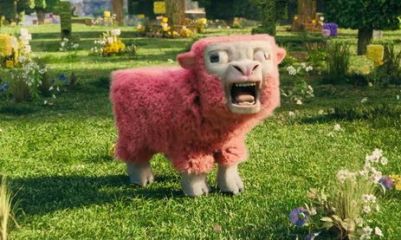
The visual design was the first thing that pulled me in. A Minecraft Movie keeps the block-based identity instead of sanding it down into a smooth fantasy landscape. That choice matters. The Overworld looks artificial in the best way, as though every mountain, tree, animal, and village has been arranged by a playful mind with a strict fondness for right angles. I liked that the movie lets the world stay awkward. Minecraft has never needed elegance to be beautiful.
The environments work because they feel usable. I did not just look at cliffs, forests, fields, and caves as scenery. I kept imagining where I would build, which route I would take, and what I would gather first. That is a specific Minecraft reaction, and the film creates it often. Even when the frame gets crowded, the basic appeal remains clear: this is a world that invites action. It does not only want to be admired. It wants to be changed.
Steve Feels Like a Player Who Never Logged Out
Steve could have been treated as a simple mascot, but the movie gives him a more entertaining role. I saw him as someone who has spent so much time inside the Overworld that its logic has become his normal language. He reads materials, tools, creatures, and terrain with the confidence of a veteran player. His reactions are funny because he treats absurd things as practical problems.
What I enjoyed most about Steve is that he represents Minecraft fluency. To a newcomer, a block is just a block. To Steve, it is a bridge, a wall, a weapon, a roof, a path, or the start of a machine. That mindset is central to the game. The movie is at its best when it lets Steve explain the world through action rather than long speeches. He makes the strange rules feel natural, and that helps the audience understand why Minecraft players become so attached to this universe.
The Human Cast Learns the Language of Making
The main characters work best when they stop behaving like visitors and start thinking like builders. At first, the Overworld overwhelms them. That makes sense, because Minecraft can feel simple from a distance and confusing once you are inside its systems. The film captures that shift from panic to curiosity. I liked watching the characters realize that survival here is not only about speed or bravery. It is about noticing patterns and using what is available.
The emotional side of the film comes from that learning curve. Each character has to adjust to a world where imagination has practical value. A clever idea can become a structure. A mistake can become a new route. A strange material can become the missing piece of a plan. That gives the movie a playful, hands-on quality. It also makes the characters more interesting when they build, repair, test, and rethink instead of only reacting to chaos around them.
Comedy Built From Game Logic
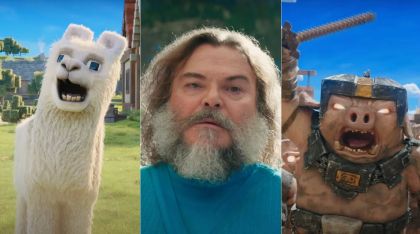
The humor in A Minecraft Movie is broad and sometimes very loud, but I preferred the jokes that came directly from Minecraft’s rules. The funniest moments are not just random lines or exaggerated reactions. They are the scenes where the world itself creates the joke. Cubic animals, stiff villagers, sudden crafting solutions, odd physics, and the seriousness of simple materials all give the film a comic personality that feels connected to the game.
Some jokes try too hard, and I felt that unevenness. Still, Minecraft has always had a strange comic rhythm. One moment can feel peaceful, and the next can become ridiculous because a creature wandered into the wrong place or a plan collapsed for a very basic reason. The movie understands that kind of absurdity. When it trusts the source material’s weirdness, the humor feels organic. When it reaches for easy noise, it becomes less memorable.
Crafting Turns Into Cinema
Crafting is one of the movie’s most important translation challenges. In the game, crafting is functional and quick. On screen, it needs energy, clarity, and surprise. I liked how the film treats crafting as a visual event. Materials have meaning. Wood suggests a beginning. Stone suggests progress. Iron suggests confidence. Redstone suggests that the world has deeper systems waiting to be understood.
The movie makes crafting feel like problem solving rather than a menu action. That is the right approach. Minecraft is not only about having items. It is about understanding how items connect. The film occasionally speeds past this idea, but when it pauses to show characters figuring things out, it becomes much more satisfying. I wanted more scenes where invention took center stage, because those moments feel closest to the spirit of playing Minecraft.
Aesthetics That Prefer Charm Over Realism
I appreciated that the movie does not chase realism too aggressively. Minecraft would lose something essential if every creature, object, and landscape were made too smooth or too natural. The film’s best images come from contrast: real people standing in a place that proudly refuses to behave like the real world. That contrast gives the movie its identity.
The colors are bright, the shapes are blunt, and the textures often feel toy-like. For me, that is part of the charm. A Minecraft Movie looks like a fantasy adventure assembled from digital building pieces, and that suits the material. Not every creature design fully worked for me, especially when extra detail made simple designs feel busier than necessary. But the overall aesthetic has confidence. It lets square things stay square, which is exactly what this adaptation needs.
The Action Works Best When It Becomes Improvisation
The action scenes are most engaging when characters solve problems in Minecraft-specific ways. I was less interested in standard running and shouting than in moments where someone uses blocks, terrain, tools, or crafted objects to change the situation. That is where the movie feels distinct. It reminds me that Minecraft action is rarely about polished moves. It is about improvisation.
This practical style gives the film a different flavor from many fantasy adventures. The characters do not simply discover a magical object and move forward. They have to work with the environment. They stack, dig, build, redirect, and experiment. I liked that physical creativity became part of the spectacle. The movie could have leaned into this even more, but the scenes that use the world as a toolkit are easily among its most enjoyable.
Fan Service With a Playful Pulse
A Minecraft Movie contains plenty of recognizable details for fans, but I liked that many of them are woven into the world rather than displayed like museum items. Familiar creatures, tools, materials, and sounds appear in ways that help build atmosphere. The movie knows that fans do not always need a loud announcement. Sometimes a small cue is enough.
That said, the film also wants to be accessible to people who have never played Minecraft. I think it mostly succeeds because the core idea is simple: ordinary people enter a world where imagination becomes practical. Fans may catch more references, but newcomers can still understand the basic pleasure of the story. The movie treats Minecraft knowledge as a language that can be learned, not as a wall between audiences.
The Soundscape Carries Old Player Memories
The sound design gave me some of my favorite reactions. Minecraft has always had a very specific audio personality. Small noises matter. Footsteps, item sounds, creature calls, and soft environmental cues can change the mood quickly. The movie uses that memory well. Certain sounds immediately brought me back to long play sessions, even when the scene itself was moving in a more cinematic direction.
Music and sound help the film balance wonder with nervous energy. The Overworld can be bright and inviting, but it can also feel unpredictable. I liked when the audio left space for that uncertainty. Minecraft is not only colorful blocks and jokes. It also has quiet tension, especially when a player enters a dark place without knowing what waits deeper inside. The movie touches that feeling in a way that made the world seem more alive.
Why the Movie Feels Like Minecraft Instead of Just Looking Like It
What separates A Minecraft Movie from a shallow adaptation is its interest in the act of making. The film understands that Minecraft is not beloved only because of its creatures or square design. It is beloved because it gives players permission to shape their surroundings. That feeling appears throughout the movie whenever characters turn confusion into invention.
I did not need the film to recreate a perfect play session. A movie cannot fully capture the private rhythm of gathering resources, arranging chests, building a strange house, getting lost, and returning with a new idea. But it can capture the mindset behind those actions. A Minecraft Movie does that when it shows characters learning to see every object as potential. A block is never just a block. It is a decision waiting to happen.